
Table of Contents
- Why Boston’s Heating Season Punishes Unprepared Buildings
- What a Complete Pre-Season Heating Service Actually Covers
- Boston’s Three Common Heating System Types and Their Failure Modes
- Cold Zone Mapping: The Step Most Boards Skip
- Carbon Monoxide and Combustion Safety Obligations
- What a Mid-Winter Heating Failure Actually Costs
- How Condominium Management Companies in Boston Run Heating Readiness
- Frequently Asked Questions
Introduction
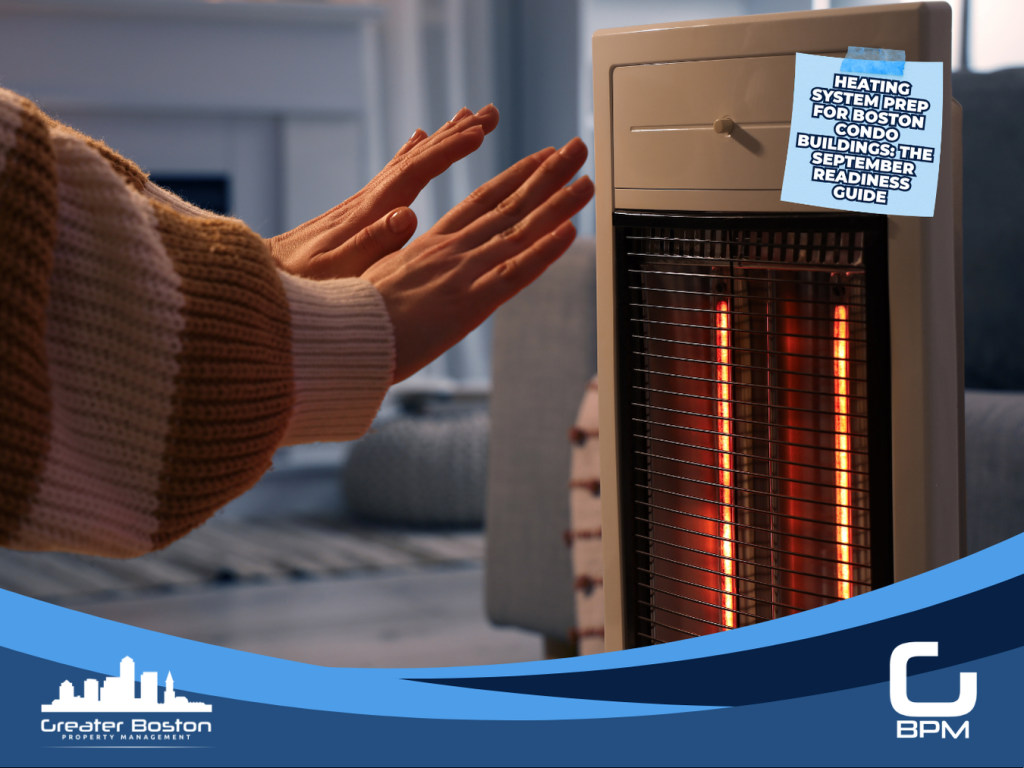
Boston’s heating season does not arrive gradually. It arrives on a Tuesday in early October when the overnight low drops to 38°F, and every building in the city calls for heat on the same morning.
Buildings that were serviced in September come up cleanly. Buildings that were not discover their problems simultaneously with several thousand other properties — which is precisely when HVAC availability disappears and emergency rates apply. For condominium management in Boston, that single dynamic is why heating readiness is a September task rather than an October one.
This guide covers the complete pre-season sequence: what a real service includes, how Boston’s specific building stock fails, the cold-zone mapping most boards skip, and what a mid-winter failure genuinely costs.
📊 Quick Stats: Boston Condo Heating Readiness
| Factor | Detail |
| HVAC booking lead time by mid-September | 3–4 weeks |
| Typical first heating demand in Boston | Late September to early October |
| Emergency service premium vs. contracted rate | 30–75%, plus after-hours surcharge |
| Most common cause of mid-winter failure | Deferred pre-season service |
| Frozen pipe claim range | 5,000–25,000 |
| CO detector requirement | 527 CMR 31.00 |
| Refrigerant work certification | EPA Section 608 required |
Section 1: Why Boston’s Heating Season Punishes Unprepared Buildings
Three characteristics of the Boston market combine to make heating readiness unusually consequential here.
The Season Starts Faster Than Boards Expect
Boston does not have a long shoulder season. Overnight lows drop through the 40s in late September and hit the 30s by mid-October. Consequently, the gap between “we should schedule that” and “the system needs to work tonight” is frequently two weeks.
Boards that book service in August or the first days of September get standard rates and their preferred contractor. Boards that wait until the first cold night join a queue behind every other property in the region.
Eight Idle Months Create Real Problems
A heating system that ran acceptably in April has then sat unused through May, June, July, and August. Seals dry out. Circulator pumps seize. Controls drift out of calibration. Rodents nest in flues and intakes.
Furthermore, problems that were marginal at the end of last season — a pump running hot, a control cycling erratically — have not improved over the summer. They surface under load.
Boston’s Building Stock Compounds the Risk
Much of Boston’s condo inventory occupies structures originally built as single-family homes or small multifamilies, later converted. Heat distribution in those buildings is frequently uneven by design, and the plumbing runs that serve upper units often pass through exterior walls, unheated stairwells, or crawl spaces.
As a result, a heating shortfall in a Boston condo building is rarely just a comfort problem. It is a frozen pipe risk concentrated in the units furthest from the heat source.
✅ The core dynamic: September heating service is not maintenance. It is the identification step for problems that become emergencies in January — when repair costs multiply and contractor availability collapses.
Section 2: What a Complete Pre-Season Heating Service Actually Covers
“Tune-up” is not a scope. When you book pre-season service, confirm the contractor will perform and document each of the following.
Combustion Analysis and Efficiency Testing
The technician measures flue gas composition — oxygen, carbon monoxide, carbon dioxide, stack temperature — and calculates combustion efficiency. This is the single most diagnostic test performed on a fuel-burning appliance.
Elevated CO in the flue indicates incomplete combustion. Low efficiency indicates a burner, heat exchanger, or draft problem. Both are invisible without instrumentation.
Require a printed or emailed combustion report with the readings. A service visit that produces no numbers produced no analysis.
Heat Exchanger Inspection
The heat exchanger separates combustion gases from the air or water distributed through the building. A cracked exchanger allows combustion products — including carbon monoxide — into the occupied space.
Inspection methods vary by equipment type and may include visual inspection, camera inspection, or pressure testing. For any appliance over fifteen years old, this inspection is the most important part of the visit.
Burner Cleaning and Adjustment
Soot, scale, and debris accumulate on burner surfaces and degrade combustion. Cleaning restores efficiency and reduces CO production. Adjustment aligns the fuel-air mixture to manufacturer specification.
Safety Control Testing
Every safety control should be tested to confirm it actually trips: high-limit aquastat or temperature limit, low-water cutoff on boilers, pressure relief valve, flame sensor or flame rod, draft proving switch, and the roll-out switch.
These controls exist to prevent catastrophic failure. A control that has silently failed provides no protection and gives no warning that it has failed.
Circulator Pump and Distribution Check
On hydronic systems, confirm every circulator runs, check for seal leakage, and verify zone valves open and close. On forced-air systems, inspect the blower, check belt tension where applicable, and confirm airflow.
Expansion Tank and System Pressure
On hydronic systems, confirm the expansion tank holds correct charge and system pressure sits within the design range. A waterlogged expansion tank causes pressure relief valve discharge, which boards frequently mistake for a leak.
Filter Replacement and Controls Calibration
Replace all filters. Verify thermostat calibration against an independent thermometer. Confirm any building management system or outdoor reset control is programmed for the season.

Section 3: Boston’s Three Common Heating System Types and Their Failure Modes
Knowing which system your building has determines what deserves the most attention.
Steam Systems — Common in Pre-1940 Boston Buildings
Many Back Bay, South End, and Beacon Hill condo conversions retain original steam distribution. Steam is durable but unforgiving of neglect.
Primary failure modes: water level control failure, sediment accumulation in the boiler, failed air vents producing uneven heat, and steam trap failure on two-pipe systems.
What to insist on: low-water cutoff testing and boiler flushing. Sediment reduces heat transfer and causes hot spots that crack sections. Additionally, replacing failed air vents is inexpensive and resolves most “the top floor is freezing” complaints in steam buildings.
Hydronic (Hot Water) Systems — The Most Common Conversion Retrofit
Hot water baseboard and radiator systems dominate mid-century and converted Boston buildings.
Primary failure modes: circulator pump seizure, zone valve failure, air binding in the loops, expansion tank waterlogging, and mixing valve drift.
What to insist on: system purging to remove trapped air, circulator inspection, and expansion tank charge verification. Air-bound loops are the most common cause of a single cold zone in an otherwise functional hydronic building.
Forced Air and Heat Pumps — Newer Construction and Unit-Level Systems
Newer Boston condo construction and many unit-level retrofits use forced air furnaces, ductless mini-splits, or air-source heat pumps.
Primary failure modes: heat exchanger cracking on gas furnaces, defrost control failure on heat pumps, refrigerant loss, and blower motor failure.
What to insist on: for heat pumps specifically, verify defrost cycle operation and auxiliary heat lockout settings. A heat pump that cannot defrost properly in Boston’s freeze-thaw conditions will ice over and fail on the coldest nights.
Licensing note: any refrigerant work requires EPA Section 608 certification. Verify the company’s Massachusetts license at mass.gov/how-to/check-a-professional-license.
Section 4: Cold Zone Mapping — The Step Most Boards Skip
Pre-season service verifies the equipment works. It does not verify that heat actually reaches every part of the building. Those are different questions, and the second one is where frozen pipes originate.
What Cold Zone Mapping Involves
Walk the entire building on a cold day — ideally the first genuinely cold week — with a simple infrared thermometer or even just your hands, and record the temperature in every space.
Spaces that most commonly run cold in Boston condo buildings:
- Crawl spaces and basement perimeters
- Unheated stairwells and vestibules
- Parking structures and garages with plumbing overhead
- Mechanical rooms with exterior walls
- Units at building corners, particularly top-floor corners
- Rooms above unheated garages or porches
- Any space that was added or enclosed after original construction
Why This Matters More Than Comfort
Every cold zone that contains water piping is a frozen pipe waiting for a sufficiently cold night. Boston’s coldest stretches routinely reach single digits, and a pipe in a 38°F cavity on a 50°F day sits well below freezing when outdoor temperatures drop 40 degrees further.
Consequently, cold zone mapping is a freeze-prevention exercise, not a comfort survey.
What to Do With What You Find
For each cold zone containing piping, select the appropriate intervention: add insulation to the space or the pipe, install or verify heat trace cable, improve air sealing to stop cold infiltration, adjust the heating distribution to serve the zone, or in some cases reroute the piping.
Document the map with dates and temperatures. It becomes the reference for next year and the evidence of diligence if a freeze claim ever arises.
⚠️ The most common Boston freeze location: piping serving a top-floor unit that runs through an exterior wall cavity or an unheated attic knee wall. It is invisible, unheated, and the last place anyone checks.
Section 5: Carbon Monoxide and Combustion Safety Obligations
Heating season is CO season. Massachusetts imposes specific requirements, and condo associations carry responsibility for common areas.
The Massachusetts Requirement
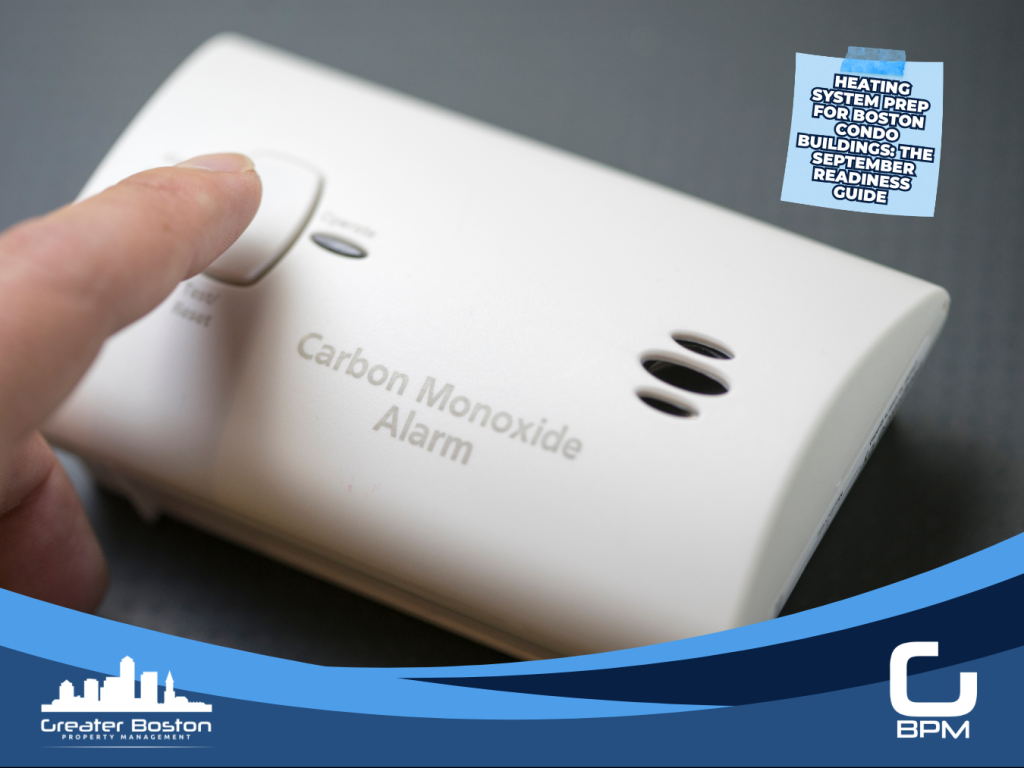
Under 527 CMR 31.00, carbon monoxide alarms are required on every level of residential dwellings, including habitable portions of basements and attics, and within ten feet of bedroom doors.
What associations should complete in September:
- Test every CO alarm in common areas and document the date and result
- Replace any CO alarm exceeding its manufacturer service life — typically seven to ten years depending on model
- Send written notice to unit owners reminding them of their obligation for in-unit alarms
- Retain the testing record permanently with board minutes
Beyond Alarms — Combustion Air and Venting
CO incidents in Boston condo buildings frequently trace to venting and combustion air problems rather than equipment failure.
Check in September:
- Flue and chimney clearance — birds, debris, and collapsed liners all obstruct venting
- Combustion air openings in mechanical rooms, which get blocked by stored materials
- Vent termination clearance from windows, doors, and intakes — particularly after any exterior work
- Any newly installed exhaust fan or dryer that could depressurize a mechanical space and cause backdrafting
That last item deserves attention. A powerful new kitchen exhaust fan in a unit can depressurize a tightly sealed building enough to reverse draft on a natural-draft appliance. Boston’s older converted buildings are particularly susceptible.
Section 6: What a Mid-Winter Heating Failure Actually Costs
The case for September service is economic as much as operational.
Direct Repair Cost
A repair performed as scheduled September work runs at standard rates. The same repair as a January emergency call runs 30 to 75 percent higher, plus after-hours and holiday surcharges.
A $1,200 circulator replacement becomes a $2,000 emergency call. A $2,500 control board replacement becomes $4,000.
Extended Downtime
Emergency availability in January is measured in days, not hours. Parts that are stocked in September are backordered in January because every supplier in the region is drawing on the same inventory.
Consequently, a building may be without heat — or on partial heat — for significantly longer than the repair itself requires.
Cascading Freeze Damage
This is the cost that dominates. A heating failure during a genuine Boston cold snap does not stay a heating problem. Pipes in cold zones freeze within hours. A single burst supply line in a top-floor unit produces water damage through every floor below it.
Frozen pipe claims in Boston condo buildings routinely run $5,000 to $25,000, and multi-unit water damage exceeds that substantially.
Habitability and Liability Exposure
Massachusetts imposes heating obligations on residential rental units, and associations carry a general duty of care regarding common areas. A prolonged heating failure in a building with elderly or medically vulnerable residents creates genuine liability exposure beyond the repair cost.
Insurance Consequences
Insurers routinely examine maintenance history when adjusting heating-related and freeze-related claims. An association that cannot produce service records for the heating system faces a materially harder claim.
Section 7: How Condominium Management Companies in Boston Run Heating Readiness
Heating readiness is a sequence, not a task — and it runs during the same weeks as annual meeting preparation and fall vendor booking.
Service Is Booked in August
Professional condominium management companies in Boston hold standing relationships with heating contractors across their portfolios. September service dates are confirmed in August, before lead times extend and before the first cold snap consumes remaining capacity.
The Scope Is Specified, Not Assumed
Rather than accepting whatever the contractor’s standard visit includes, the management company specifies the scope — combustion analysis with a written report, safety control testing, heat exchanger inspection — and verifies the documentation arrives.
Cold Zone Maps Are Maintained Year Over Year
The zones that ran cold last winter are known before this winter starts. Interventions are tracked, and the map is updated each season rather than rediscovered.
Documentation Supports Claims Automatically
Service reports, combustion readings, CO testing records, and cold zone temperatures enter a centralized record with dates. When an insurer asks for maintenance history, it exists.
Emergency Response Runs Through a Contracted Vendor
When something fails in January, the dispatch goes to a contractor who already knows the building, already has a contracted rate, and already has a response obligation — not to whoever answers the phone at 11 p.m.
🔗 Related reading → How to Choose a Condo Management Company in Boston
Frequently Asked Questions
Book in August for September service. Boston HVAC lead times reach three to four weeks by mid-September, and once the first cold snap arrives, remaining capacity is consumed by emergency calls that take dispatch priority over routine pre-season work. Associations booking in October generally pay premium rates and accept whatever availability remains.
At minimum: combustion analysis with a written report, heat exchanger inspection, burner cleaning and adjustment, safety control testing (high limit, low-water cutoff, pressure relief, flame sensor, roll-out switch), circulator pump and distribution check, expansion tank and system pressure verification, filter replacement, and thermostat calibration. Require documentation of the readings — a visit that produces no numbers performed no analysis.
Cold zone mapping means walking the building on a cold day and recording the temperature in every space, particularly crawl spaces, unheated stairwells, garages with overhead plumbing, and corner units. Any cold zone containing water piping is a frozen pipe risk. This is a freeze-prevention exercise rather than a comfort survey, and it is the step most self-managed associations skip entirely.
Yes. Massachusetts 527 CMR 31.00 requires CO alarms on every level of residential dwellings, including habitable basement and attic areas, and within ten feet of bedroom doors. Associations are responsible for common area alarms and should test them annually, document the date and result, replace units exceeding their service life, and send written reminders to owners regarding in-unit alarms.
The repair itself typically runs 30 to 75 percent above standard rates as an emergency call, plus after-hours surcharges. However, the dominant cost is usually cascading freeze damage — frozen pipe claims in Boston condo buildings routinely run $5,000 to $25,000, and multi-unit water damage from a single burst supply line exceeds that substantially. Extended downtime from January parts backorders compounds both.
Yes, materially. Insurers routinely examine maintenance history when adjusting heating-related and freeze-related claims. An association that can produce dated service reports, combustion readings, and CO testing records is in a substantially stronger position than one that cannot. Retain all heating documentation permanently with board meeting minutes.
Conclusion
Heating readiness in Boston is decided in August and executed in September. Not because the season starts then, but because that is when contractors are available, parts are stocked, and problems can be found under no time pressure.
The sequence is straightforward: book the service in August, specify the scope rather than accepting a generic tune-up, require documentation of the combustion readings, map the cold zones and protect the piping in them, test and document the CO alarms, and file everything.
None of it is complicated. All of it gets deferred — and the deferral cost arrives in January, in the form of an emergency call, a backordered part, and a burst pipe in the one cold cavity nobody checked.
📥 Free Resource: Boston Condo Heating Readiness Checklist
Download the complete pre-season checklist — full service scope by system type, cold zone mapping worksheet, CO compliance record, and a contractor documentation checklist.
[Download the Free Heating Readiness Checklist (PDF) →]
Includes separate service scopes for steam, hydronic, and forced-air systems.
Is Your Building Ready for the First Cold Night?
Greater Boston Property Management coordinates heating readiness for condo associations across Greater Boston — service booked in August, scope specified, documentation retained, and emergency dispatch through contracted vendors.
[Request a Free Heating Readiness Review →]
No obligation. We will review your service history, your cold zone exposure, and your CO compliance status.
Continue Reading: The Boston Fall Maintenance Series
- ← Series hub: The Complete Boston Fall Maintenance Guide
- → Next: Ice Dam Prevention: The Boston Condo Guide
- → The Complete Boston Condo Winterization Guide
- ← Bridge post: Book Now, Save Later: Fall Vendor Booking in August
- ← Evergreen: Condo Management in Boston: What Every Landlord Needs to Know