
Table of Contents
- Why Summer Is the Most Critical Season for Boston Condo Management
- Exterior Checklist: 4 Tasks for the Building Envelope
- HVAC and Mechanical: 4 Tasks Before the First Heat Wave
- Safety and Compliance: 4 Tasks Boston Trustees Must Not Skip
- How Professional Condo Management in Boston Handles Summer Prep
- Frequently Asked Questions
Introduction
Summer arrives fast in Boston — and for condo owners and trustees, that means a narrow window to complete critical maintenance before the heat, humidity, and peak vendor demand arrive together. Condo management in Boston is a year-round responsibility, but summer preparation is the season where proactive trustees separate themselves from reactive ones.
Whether you manage a three-unit brownstone in the South End or a fifteen-unit association in Brookline, completing these 12 tasks before July is the single most effective thing you can do to protect your building, stay compliant with Boston and Massachusetts regulations, and avoid the emergency repair calls that derail summer budgets.
This checklist is built specifically for Greater Boston’s climate, building stock, and regulatory environment. Let’s get into it.
Quick Stats: Boston Condo Summer Maintenance
| Stat | Detail |
| Boston average summer high | 82°F — with humidity indexes regularly exceeding 95°F |
| #1 summer emergency repair | HVAC failure during heat waves |
| Peak vendor demand window | Mid-June through August — book early or pay more |
| Most overlooked summer task | Flat roof and membrane inspection |
| Average emergency repair premium | 30–50% above standard rate when booked same-week |
Section 1: Why Summer Is the Most Critical Season for Boston Condo Management
Boston’s building stock is older than almost any other major American city. Back Bay brownstones, South End row houses, Beacon Hill conversions, and Charlestown triple-deckers were built in an era before modern roofing membranes, sealed HVAC systems, and today’s extreme summer heat cycles. Consequently, summer in Boston puts unique stress on condo buildings that newer construction in other markets simply does not face.
What Boston Summer Actually Does to Your Building
The combination of heat, humidity, and Boston’s intense UV exposure creates a predictable set of stressors that accelerate every summer between June and August.
Thermal expansion and contraction causes caulking and sealants around windows, doors, and masonry joints to crack and pull away. As a result, water intrusion pathways open up — not during summer itself, but during the fall rains that follow immediately after.
Flat roof membranes — common on Boston’s Victorian-era residential buildings — reach surface temperatures of 150°F or more on hot days. Over time, this UV and heat exposure causes blistering, cracking, and seam failure that is invisible until water enters the building.
HVAC systems that were installed years ago and never serviced are most likely to fail during the first real heat wave of June. In Boston, that heat wave frequently arrives before residents expect it, and emergency HVAC service in the metro area books out within hours.
Pest pressure peaks dramatically in summer. Carpenter ants, termites, and rodents all become significantly more active in Boston’s warmer months, and common-area infestations are far easier to prevent than to remediate.
Why the Window Is Narrow
Professional condo management in Boston operates on tight summer schedules because every association in the region is trying to accomplish the same things at the same time. HVAC service companies, roofing contractors, and pest control vendors all face peak demand from late May through August.
Furthermore, the City of Boston Inspectional Services Department conducts a higher volume of inspections in summer, when building activity and code violations are more visible. Therefore, associations that wait until June to begin scheduling work often find that their preferred vendors are unavailable — or that they are paying emergency rates for work that should have been routine.
✅ The bottom line: The best time to start your summer maintenance schedule is April. The second best time is right now. Completing these 12 tasks before July keeps your building protected, your vendors available, and your costs predictable.

Section 2: Exterior Checklist — 4 Tasks for the Building Envelope
The building envelope — everything that separates the interior of your condo from the outside — takes the most direct summer punishment. These four exterior tasks are specifically sequenced to catch winter damage before summer heat and humidity compound it.
Task 1: Roof and Gutter Inspection After Spring Thaw
Boston’s winters are brutal. By the time spring arrives, your roof has survived months of freeze-thaw cycling, ice dams, heavy snow loads, and wind events. Consequently, the first exterior task every spring — ideally in April or May — is a thorough roof and gutter inspection.
What to look for:
- Cracked, lifted, or missing shingles on pitched roofs
- Blistering, bubbling, or seam separation on flat roof membranes
- Flashing failures at chimneys, skylights, and parapet walls
- Gutters detached from fascia boards or sagging under debris weight
- Downspout extensions directing water away from the foundation
Who to call: A licensed Massachusetts roofing contractor. For flat roof membrane systems common on Boston’s older residential buildings, specifically request a contractor with EPDM or TPO membrane experience. Verify their MA Home Improvement Contractor (HIC) registration at contractorhub.mass.gov/s/hic-contractor-search before any work begins.
Why it matters in summer: A roof deficiency that survives spring without causing obvious leaks frequently fails catastrophically during Boston’s summer afternoon thunderstorms. Additionally, gutter blockages that develop in spring create moisture intrusion at the fascia and soffit that goes undetected until fall.
Task 2: Masonry and Caulking Assessment
Boston’s Victorian-era condo buildings rely heavily on brick masonry, limestone, and granite for their structural and aesthetic character. Unfortunately, this beautiful heritage stock is particularly vulnerable to the freeze-thaw cycling that characterizes every Boston winter.
What to inspect:
- Mortar joints between bricks — look for crumbling, gaps, or staining that indicates water penetration
- Window and door surround caulking — should be continuous, flexible, and adhered on both sides
- Parapet walls at roofline — often the first place where water enters Boston’s older condo buildings
- Lintels above window and door openings — stone and cast iron lintels crack under freeze-thaw stress
The summer connection: Repointing mortar and replacing caulking is most effective when done in warm, dry weather with temperatures above 50°F — which makes late May through September Boston’s prime window for masonry work. Moreover, completing this work before summer’s heavy rain events prevents moisture from reaching building interiors during the wet fall season.
⚠️ Trustee note: Masonry repointing requires a licensed contractor and, for buildings in historic districts (Beacon Hill, Back Bay, South End), may require approval from the Boston Landmarks Commission. Always verify permit requirements with the City of Boston Inspectional Services Department before contracting work.
Task 3: Window and Entry Door Weatherstripping
Boston’s summer humidity is as damaging to building interiors as winter cold. Specifically, poorly sealed windows and entry doors allow humid summer air to enter building envelopes and common areas, creating condensation on cold surfaces, promoting mold growth, and driving up cooling costs significantly.
What to check:
- Compression weatherstripping on entry doors — should compress fully when door closes
- Window glazing compound — should be continuous, without cracks or gaps
- Door sweeps at base of exterior entry doors and garage doors
- Common area window latches — windows that don’t close fully allow both humidity and pest entry
Practical tip: Assign this inspection to a trustee walkthrough in late April. It requires no tools and no contractor — just a systematic room-by-room check of every common area exterior opening. Budget two hours for a standard Boston condo building of 6–10 units.
Task 4: Exterior Lighting and Common Area Safety Check
Summer increases the use of common outdoor areas — decks, patios, parking areas, and building entries — dramatically. Therefore, exterior lighting failures and common area hazards that went unnoticed through winter become safety and liability risks as soon as warm weather brings residents outside.
What to inspect:
- All exterior light fixtures — replace failed bulbs and check for water intrusion in fixture housings
- Pathway lighting from street to building entry — critical for ADA compliance and liability management
- Parking area lighting — Boston’s longer summer evenings mask lighting failures that residents notice in fall
- Deck and patio surfaces — check for loose boards, protruding fasteners, and deteriorated railings
- Handrails on exterior stairs — test for stability; loose handrails are a leading source of slip-and-fall liability
Section 3: HVAC and Mechanical — 4 Tasks Before the First Heat Wave
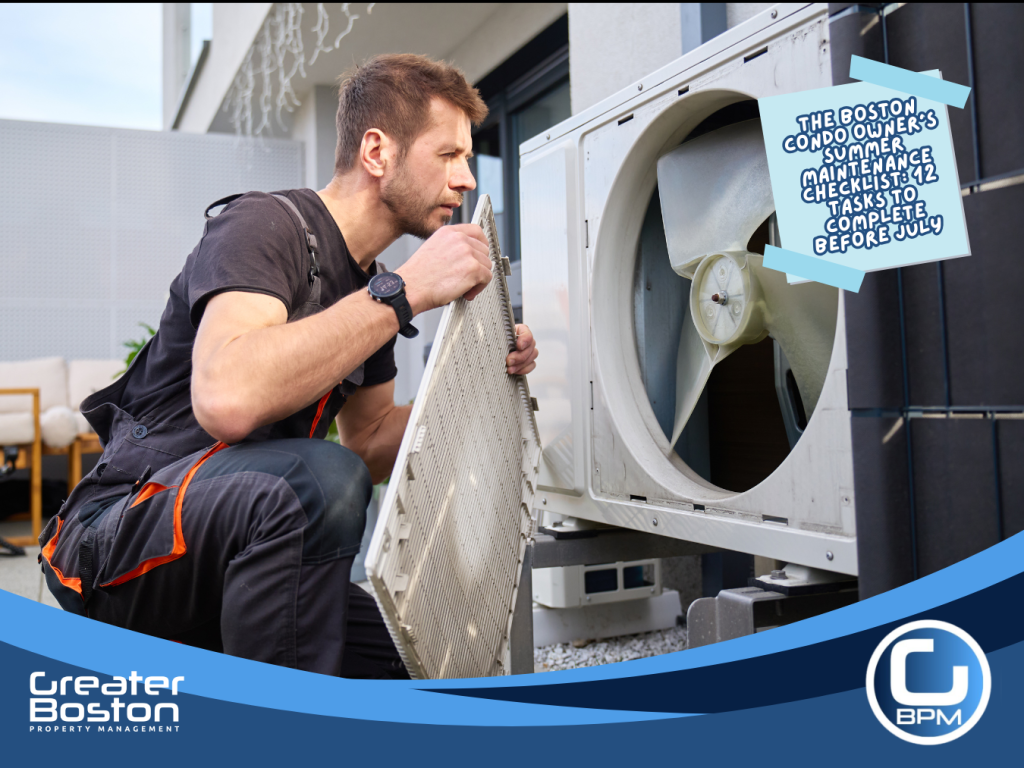
HVAC failure during a Boston heat wave is one of the most disruptive and expensive emergencies a condo association can face. Fortunately, it is also almost entirely preventable with proper seasonal preparation.
Task 5: Central Cooling System Service
Every central cooling system serving common areas or shared mechanical rooms should receive professional service before June 1. This includes central air conditioning units, ductless mini-split systems serving hallways and common areas, and any cooling equipment in mechanical rooms or on rooftops.
What a proper cooling service covers:
- Refrigerant level check and leak test
- Coil cleaning (evaporator and condenser)
- Filter replacement
- Electrical connection inspection and tightening
- Thermostat calibration
- Condensate drain clearing
Book early: Boston HVAC service companies begin their backlog in April. By mid-May, appointment availability for non-emergency residential service frequently extends three to four weeks. Consequently, associations that delay scheduling until June routinely find themselves without service capacity when the first heat advisory hits.
Licensing note: Any HVAC work involving refrigerant handling requires an EPA Section 608 certified technician. Verify credentials before authorizing work. Additionally, confirm that the service company carries workers’ compensation and general liability insurance, with your association named as an additional insured.
Task 6: HVAC Filter Replacement Throughout the Building
Beyond central systems, individual unit HVAC filters and any common-area ventilation filters should be replaced on a quarterly schedule — which means a full-building filter replacement should occur in late May or early June before summer air quality demands peak.
Why this matters specifically in Boston summers: Boston’s summer air quality frequently degrades during heat events, with elevated particulate matter and ozone levels. Clean HVAC filters are the first line of defense for residents with respiratory conditions. Furthermore, dirty filters force systems to work harder, increasing energy consumption and accelerating mechanical wear.
Practical approach for associations: Include filter replacement as a standard item in your recurring maintenance service authorization. Greater Boston PM coordinates building-wide filter replacement as part of our standard seasonal service protocol — eliminating the need for individual unit coordination.
Task 7: Common Area Ventilation and Exhaust Check
Laundry rooms, trash areas, parking garages, and mechanical rooms all depend on mechanical ventilation to remove heat, moisture, and odors. These systems frequently go uninspected for months and are particularly important to check before summer heat amplifies their demands.
What to inspect:
- Laundry room exhaust fans — confirm they are operational and that dryer vent ductwork is clear
- Trash room ventilation — critical for odor control and pest prevention in summer heat
- Parking garage ventilation — carbon monoxide accumulation risk increases with summer temperatures
- Boiler and mechanical room ventilation — even in summer, mechanical rooms require adequate airflow
✅ Safety note: Dryer vent cleaning is one of the most underperformed maintenance tasks in Boston condo buildings. According to the U.S. Fire Administration, clogged dryer vents cause approximately 2,900 building fires annually. Schedule professional dryer vent cleaning at least annually — ideally in spring before summer usage peaks.
Task 8: Hot Water System Inspection
Summer is the optimal time to inspect domestic hot water systems because the thermal stress on the system is lower than during peak winter demand. This inspection is particularly important for Boston’s older condo buildings with boiler-based hot water systems.
What to check:
- Expansion tank pressure — should be inspected annually by a licensed MA plumber
- Pressure relief valve — test operation; a sticky or failed PRV is a safety hazard
- Anode rod condition — sacrificial anode rods in tank-type water heaters should be inspected every 2–3 years
- Circulation pump operation — common in Boston’s older hydronic hot water systems
- Insulation on hot water pipes in unheated spaces — prevents heat loss and condensation in summer
Licensing requirement: Any work on pressurized plumbing systems in Massachusetts requires a licensed MA plumber. Verify the license at mass.gov/how-to/check-a-professional-license before scheduling any service.
Section 4: Safety and Compliance — 4 Tasks Boston Trustees Must Not Skip
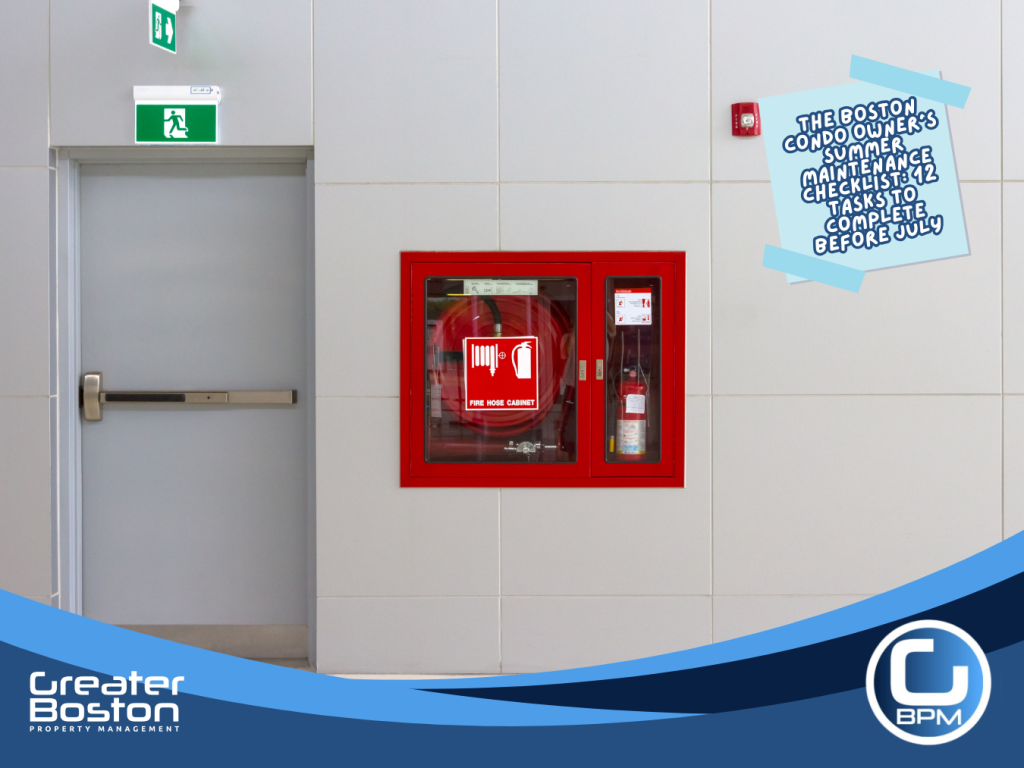
Beyond maintenance, Boston condo associations carry specific legal compliance obligations that peak in visibility during summer. These four tasks protect both the building and the trustees personally.
Task 9: Smoke and CO Detector Battery Replacement and Testing
Massachusetts law requires functioning smoke detectors and carbon monoxide detectors in all residential units and common areas. Specifically, under mass.gov/info-details/smoke-and-carbon-monoxide-alarms (the Massachusetts Smoke Detector Code), detectors must be properly maintained and tested.
Summer action items:
- Replace batteries in all battery-operated smoke and CO detectors building-wide
- Test every detector using the test button — document the date and result
- Replace any detector that fails the test or is more than 10 years old (smoke) or 7 years old (CO)
- Confirm that detectors are properly located per Massachusetts code — within 10 feet of each sleeping area and on every level of each unit
For condo associations: Trustee responsibility for detector maintenance in common areas is unambiguous. Unit interior detector maintenance is typically the unit owner’s responsibility under governing documents — but trustees should send an annual written reminder to all owners, creating a documented record of due diligence.
Task 10: Fire Escape Inspection and Boston ISD Compliance
Boston’s older residential buildings — particularly those built before 1940 — rely on exterior iron fire escapes as secondary egress. These fire escapes are subject to inspection and maintenance requirements under the City of Boston Building Code and the State Fire Code.
What to check:
- Structural integrity — test balcony platforms and stair treads for flex or movement
- Paint and rust condition — bare metal accelerates deterioration and indicates need for repainting
- Clearance — fire escape landings and stairs must remain clear of stored items, window unit air conditioners, and obstructions
- Drop ladder operation — bottom ladder drop sections must operate freely
- Window and door access — any window or door designated as fire escape access must open fully without obstruction
City of Boston requirement: The City of Boston Inspectional Services Department requires that fire escapes be maintained in a safe condition at all times. Summer is when ISD inspectors are most active, and a fire escape violation is one of the most common citations issued to Boston residential properties.
Task 11: Short-Term Rental Compliance Check
Boston’s summer tourism season brings an annual surge in unauthorized short-term rental activity in condo buildings. Every summer, Boston condo associations discover that unit owners or tenants have listed units on Airbnb and similar platforms in violation of both the City of Boston Short-Term Rental Ordinance and the association’s own governing documents.
Summer action items:
- Search Airbnb, VRBO, and similar platforms for listings that match your building’s address
- Review condo documents to confirm your STR restriction language is current and enforceable
- Send an annual pre-summer notice to all unit owners reminding them of the STR policy
- Confirm that any owner claiming an exemption has a current City of Boston STR registration on file
Why summer specifically: Boston’s summer tourist season creates the financial incentive that drives most STR violations. Owners who might not consider short-term renting in November frequently list their units during the high-demand summer months. Proactive communication before June 1 is significantly more effective than reactive enforcement after a violation is discovered.
Resource: City of Boston Short-Term Rental Information → boston.gov
Task 12: Common Area Summer Safety Audit
Before resident activity in common areas peaks with summer weather, conduct a formal safety walkthrough of all shared spaces. Document every finding with photos and dates. This audit serves both as a practical maintenance tool and as a legal record of trustee diligence.
Common area summer safety checklist:
- Pool and deck areas (if applicable) — signage, safety equipment, surface condition, drainage
- Parking areas — line markings, lighting, surface condition, drainage grates clear
- Mailroom and package areas — clear of fire hazards, lighting functional
- Bicycle storage — confirm compliance with any fire code clearance requirements
- Landscaping — trees and shrubs trimmed away from building, walkways clear
- Playground equipment (if applicable) — inspect for sharp edges, loose fasteners, deteriorated surfaces
✅ Trustee protection note: A documented common area safety audit, completed annually and filed with trustee meeting minutes, is one of the most effective protections against slip-and-fall liability claims. Massachusetts courts look favorably on associations that can demonstrate consistent, documented safety inspections.
📥 FREE DOWNLOAD: Boston Condo Summer Maintenance Checklist (PDF)
[Download the Free Printable Checklist →] All 12 tasks in a print-ready format with Boston-specific compliance notes, vendor licensing reminders, and documentation fields.
Section 5: How Professional Condo Management in Boston Handles Summer Prep
For many Boston condo associations, completing all 12 of these tasks before July is genuinely difficult. Trustees are volunteers with full-time jobs and personal lives. Vendor coordination, compliance documentation, and building walkthroughs compete with every other demand on their time.
This is one of the strongest arguments for professional condo management in Boston — not just year-round, but specifically during the narrow spring-to-summer preparation window.
What a Professional Management Company Does Differently in Summer
Vendor scheduling is handled in February. Established Boston condo management companies begin booking HVAC service, roofing inspections, pest control, and landscaping vendors in late winter — before the spring backlog builds. As a result, their client associations receive preferred scheduling at standard rates while self-managed buildings are competing for the remaining availability.
The checklist is never forgotten. Professional managers maintain seasonal maintenance calendars for every property in their portfolio. Every task on this list — and dozens more — is tracked, scheduled, and documented without relying on trustee memory or individual initiative.
Compliance documentation is automatic. Every inspection, every service visit, every safety audit is documented in a centralized management platform. When a unit owner questions whether the fire escapes were inspected, or whether smoke detectors were tested, the answer is instant and documented.
Vendor relationships produce better pricing. A management company that coordinates summer maintenance for 20 or 30 Boston condo buildings negotiates volume pricing with vendors that individual associations cannot access. In many cases, the savings on summer vendor costs alone exceed the annual management fee.
Insurance and compliance issues are caught early. Professional property managers in Boston know what the City of Boston Inspectional Services Department looks for in summer. They know the STR ordinance requirements. They know the fire code. As a result, compliance problems are addressed before they become citations — not after.
🔗 Related Reading → Condo Management in Boston: What Every Landlord Needs to Know
🔗 Related Reading → Hiring Vendors for Your Boston Condo Association
Frequently Asked Questions About Summer Condo Maintenance in Boston
Q: When should I start summer maintenance preparation for my Boston condo?
The ideal start date for summer maintenance preparation in Boston is April 1. This gives associations enough lead time to schedule HVAC service, roofing inspections, and pest control before peak summer vendor demand arrives. If you are reading this in May or June, start immediately — the tasks become more urgent and more expensive the longer you wait.
Q: Are Boston condo trustees legally required to complete summer maintenance inspections?
Trustees are not required to follow a specific summer checklist, but they are required under Massachusetts General Laws Chapter 183A to fulfill their fiduciary duty to maintain the building’s common elements and protect association assets. Failure to complete routine maintenance — including seasonal preparation — can expose trustees to personal liability if a neglected condition results in damage or injury. Documented seasonal inspections are your primary legal protection.
Q: What summer maintenance tasks am I responsible for as an individual unit owner versus the association?
Responsibility depends on your specific condo documents. Generally, the association is responsible for common areas — roof, exterior envelope, shared HVAC, fire escapes, parking areas, and hallways. Individual unit owners are typically responsible for interior maintenance, including unit HVAC filters, interior smoke detectors, and appliance maintenance. Review your master deed and declaration of trust for the specific language governing your building.
Q: How do I find licensed contractors for summer maintenance work in Boston?
Verify any contractor’s Massachusetts license at mass.gov/how-to/check-a-professional-license before authorizing work. For roofing, HVAC, and plumbing, specific trade licenses are required. Always request a Certificate of Insurance showing general liability and workers’ compensation before any contractor begins work on association property.
Q: What is the biggest summer maintenance mistake Boston condo associations make?
By far, the most common mistake is waiting until summer has arrived before scheduling vendors. By June 15, HVAC service companies, roofing contractors, and pest control vendors in Greater Boston are fully booked for weeks. The second most common mistake is skipping the fire escape inspection — which is one of the most frequently cited violations in Boston ISD summer inspections and one of the most straightforward to address proactively.
Q: Does my condo association need to notify residents about summer maintenance work?
Yes. Best practice under Massachusetts condo law is to provide reasonable written notice to all unit owners before any maintenance work that affects common areas or creates noise, disruption, or access restrictions. Your governing documents may specify a minimum notice period. Additionally, the City of Boston requires permits for most structural and HVAC work — the permit itself serves as constructive notice.
Conclusion
Summer in Boston moves fast. From the first warm weekend in May through Labor Day, your condo building faces more thermal stress, more visitor traffic, more regulatory scrutiny, and more vendor demand than any other time of year.
Completing these 12 tasks before July does not guarantee a problem-free summer — but it dramatically reduces the probability of the expensive, disruptive emergencies that derail association budgets and trustee relationships every year in Boston.
Start with the roof. Schedule the HVAC service. Walk the fire escapes. Check the STR listings. Document everything.
Condo management in Boston rewards the trustees who plan ahead and punishes those who react. This checklist is your planning tool.
📥 Free Resource: Boston Condo Summer Maintenance Checklist
Download the full printable PDF version of this checklist — all 12 tasks with compliance notes, vendor licensing requirements, and documentation fields.
[Download the Free Summer Maintenance Checklist (PDF) →] Trusted by Boston condo association trustees managing buildings across the Greater Boston metro area.
Is Your Boston Condo Building Summer-Ready?
Greater Boston Property Management coordinates seasonal maintenance preparation for Boston condo associations — vendor scheduling, compliance documentation, safety audits, and everything on this checklist — so trustees can focus on the decisions that matter, not the logistics.
[Book a Free Summer Readiness Assessment →]
No obligation. We will review your current seasonal maintenance program and identify what needs attention before July.