
Table of Contents
- Why Fall Is the Highest-Stakes Season in Boston Property Management
- The Fall Maintenance Timeline: September Through November
- Part 1 — Heating Systems and Mechanical Readiness
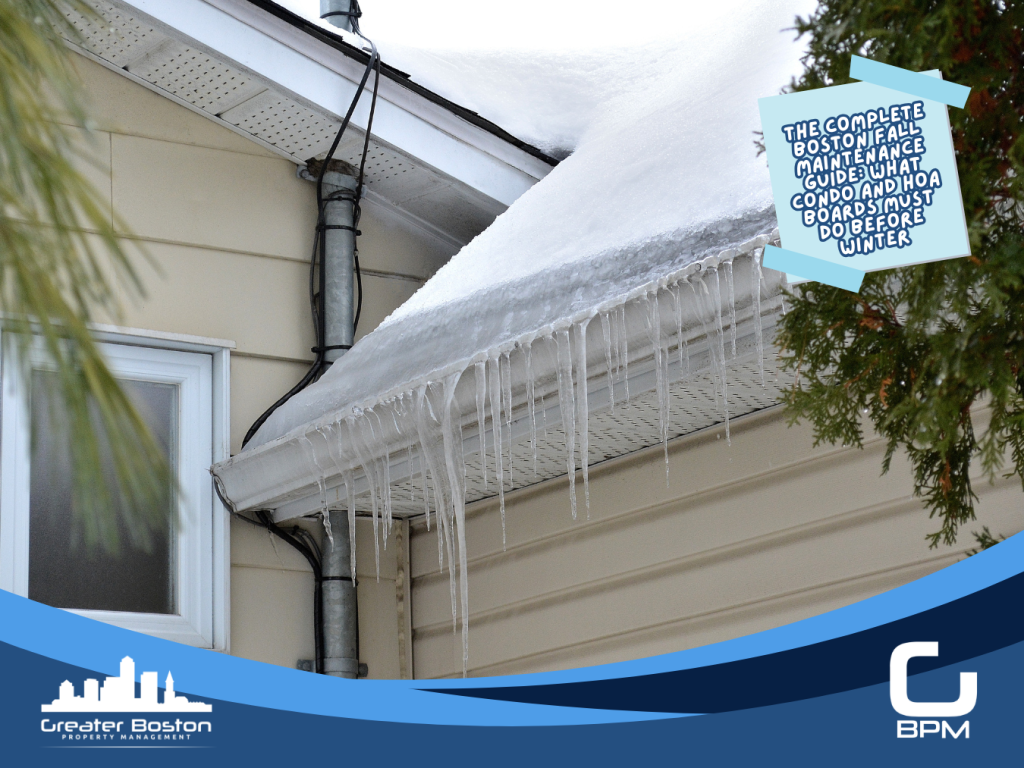
- Part 2 — Ice Dam Prevention and the Building Envelope
- Part 3 — Winterization: Water, Irrigation, and Exterior Systems
- Part 4 — Snow Removal Contracts and Winter Vendor Readiness
- Part 5 — Fall Financials, Budgets, and the Annual Meeting
- Part 6 — Documentation and Winter Emergency Preparedness
- How Professional Management Handles the Fall Sequence
- Frequently Asked Questions
Introduction
Boston winters do not negotiate. Ice dams form whether or not the gutters were cleared. Heating systems fail whether or not they were serviced. Pipes freeze whether or not the irrigation lines were purged.
That is what makes Boston fall property maintenance the highest-consequence season on the calendar for condo and HOA boards. Summer failures are expensive and visible. Fall failures are expensive, invisible until January, and frequently damage multiple units at once.
This guide is the hub for our complete Boston fall maintenance series. It covers the full September-through-November sequence, links to each detailed post as it publishes, and gives boards a single reference for everything that must happen before the first hard freeze.
📊 The Boston Fall Maintenance Landscape
| Factor | Detail |
| First hard frost in Greater Boston | Mid-to-late October |
| Heating service booking lead time by mid-September | 3–4 weeks |
| Exterior work window closes | When overnight temps hold below 50°F, early-to-mid Oct |
| #1 winter insurance claim in Boston condos | Ice dam water intrusion |
| #2 winter claim | Frozen and burst pipes |
| Snow removal route commitment deadline | Around Labor Day |
| Typical annual meeting window | October–November |
| Governing statute | MGL Chapter 183A |
Section 1: Why Fall Is the Highest-Stakes Season in Boston Property Management
Every season stresses Boston buildings differently. Fall is distinct because the consequences of inaction are delayed, compounding, and concentrated in a handful of expensive failure modes.
Fall Failures Surface in January, Not October
A gutter left uncleared in October does not produce a visible problem in October. It produces an ice dam in January, water inside the building envelope in February, and a mold remediation invoice in April.
Consequently, boards receive no feedback signal during the season when correction is still possible. The work either happened in the fall, or the building pays for it in the winter.
The Window Is Narrow and Weather-Bound
Unlike summer tasks, which can slip a few weeks without real consequence, fall deadlines are set by temperature. Mortar cures above 50°F. Irrigation lines must purge before the first hard freeze. Gutters must be cleared after leaf drop but before ice forms.
Boston compresses all of that into roughly eight weeks between mid-September and mid-November.
Fall Governance Load Collides With Fall Maintenance Load
October and November are also annual meeting season for most Boston associations. Budget development, reserve disclosure, trustee elections, and the annual meeting itself all land in exactly the weeks when heating service, winterization, and snow contracting need attention.
As a result, boards that have not front-loaded the maintenance work in September routinely find themselves choosing between governance and operations in October.
Winter Emergency Costs Are the Highest of Any Season
A summer HVAC emergency is uncomfortable. A winter heating failure in a Boston condo building with elderly residents is a genuine emergency with habitability and liability implications — and it arrives at the season’s highest labor rates.
✅ The core principle: Fall maintenance is insurance, not upkeep. Every task in this guide exists to prevent a specific winter failure that costs several multiples of the prevention.

Section 2: The Fall Maintenance Timeline — September Through November
The sequence matters as much as the tasks. Work in this order.
September: Mechanical, Governance, and Exterior Close-Out
Mechanical. Heating system service completed. Condensate systems switched over. Common area ventilation checked for heating season.
Exterior. Any masonry, sealant, or painting work identified in the summer assessment must be executed now — the temperature window closes in October.
Governance. Books closed through August. Budget drafted. Reserve disclosure prepared. Annual meeting notice sent by the required deadline.
Contracting. Snow removal contract signed. Winterization services scheduled.
October: Winterization and the Annual Meeting
Winterization. Irrigation blow-out completed before the first hard frost. Pool closed and winterized. Exterior faucets shut and drained.
Envelope. Gutters and roof drains cleared after the first leaf drop. Roof inspected for winter readiness. Attic and roof insulation checked for ice dam risk.
Governance. Annual meeting held. Budget adopted. Trustees elected. Minutes drafted.
November: Final Readiness and Emergency Preparation
Envelope. Second gutter clearing after full leaf drop. Final roof drain check.
Emergency. Winter emergency contact list distributed. Snow removal protocol communicated to residents. Vendor after-hours numbers confirmed and posted.
Systems. Heating system performance verified under actual load. Freeze protection confirmed on all vulnerable piping.
🔗 Detailed timeline → [Boston Fall Vendor Booking Calendar]
Section 3: Part 1 — Heating Systems and Mechanical Readiness
The failure this prevents: Mid-winter heating failure, frozen pipes in unheated spaces, and carbon monoxide incidents.
What Fall Heating Readiness Requires
Every boiler, furnace, rooftop unit, and heating system serving common areas needs professional pre-season service before the heating season begins. A complete service includes combustion analysis, heat exchanger inspection, burner cleaning and adjustment, safety control testing, circulator pump inspection, and thermostat calibration.
Beyond the central system, fall readiness means confirming that every unheated or marginally heated space — crawl spaces, mechanical rooms, vestibules, parking structures — will stay above freezing, and that any piping in those spaces has freeze protection.
The Boston-Specific Risk
Much of Boston’s condo stock uses hydronic heating in buildings originally designed as single-family homes or small multifamilies. Consequently, heat distribution is frequently uneven, and the coldest zones are often the ones with plumbing runs in exterior walls.
Identify those zones in September, not January.
Book by: September 1. HVAC lead times reach three to four weeks by mid-September.
🔗 Full post → [Heating System Prep for Boston Condo Buildings] (publishing September)
Section 4: Part 2 — Ice Dam Prevention and the Building Envelope
The failure this prevents: Boston’s single most common and most expensive winter insurance claim.
Why Boston Builds Ice Dams So Reliably
Ice dams form when heat escaping through the roof melts snow on the upper roof surface, and that meltwater refreezes at the colder eave. Water then backs up beneath the roofing and enters the building.
Three conditions produce them: inadequate attic insulation, air leakage from heated space into the roof assembly, and inadequate roof ventilation. Boston’s older housing stock frequently has all three.
What Fall Prevention Actually Involves
Clear the drainage. Gutters, downspouts, and roof drains must be clear before ice can form. In Boston this generally requires two clearings — one after the first leaf drop and one after full drop.
Check the insulation. Inspect attic insulation depth and coverage, particularly at the eaves where insulation is commonly compressed or missing.
Seal the air leaks. Recessed lights, attic hatches, plumbing penetrations, and chimney chases all leak heated air into the roof assembly. Sealing them is the single highest-value ice dam intervention.
Verify the ventilation. Soffit and ridge venting should be unobstructed. Insulation blocking soffit vents is extremely common and directly causes ice damming.
🔗 Full post → [Ice Dam Prevention: The Boston Condo Guide] (publishing September)
Section 5: Part 3 — Winterization: Water, Irrigation, and Exterior Systems
The failure this prevents: Burst pipes, cracked irrigation lines, and freeze damage to exterior fixtures.
Irrigation Winterization
Irrigation systems need a compressed-air blow-out to purge every line, valve, and head before the first hard frost — typically mid-to-late October in Greater Boston.
Water left in the lines expands when it freezes, cracking PVC, splitting heads, and damaging valves. The spring repair cost routinely exceeds the winterization cost several times over.
Book by: September 15.
Pool Winterization
Pool closing requires balanced chemistry, equipment drainage, line blow-out, cover installation, and chemical storage or disposal per Massachusetts Board of Health requirements.
Book by: September 15.
Building Water Systems
Shut and drain all exterior hose bibs. Confirm freeze protection on any piping in unheated spaces. Verify that heat trace, where installed, is functional before it is needed.
Additionally, confirm the location of every main and zone shutoff, and make sure at least two trustees know where they are. A burst pipe at 2 a.m. is not the moment to go looking.
🔗 Full post → [The Complete Boston Condo Winterization Guide] (publishing October)
Section 6: Part 4 — Snow Removal Contracts and Winter Vendor Readiness
The failure this prevents: Slip-and-fall liability, unplowed access, and emergency-rate winter service.
The Contract Terms That Matter Most
Snow removal is Boston’s highest-risk seasonal contract. Vague terms produce disputes during exactly the conditions when disputes are hardest to resolve.
Confirm in writing: trigger depth for automatic service, response time after snowfall ends, salting protocol and frequency, whether walkways and stairs are included, slip-and-fall liability allocation, per-event versus seasonal pricing, and the snow relocation plan when on-site storage fills.
The most common and most costly omission: walkways, stairs, and building entries. Many Boston snow contracts cover drive lanes and parking only. If pedestrian surfaces are not explicitly named, assume they are excluded — and that the association carries the exposure.
Sign by: Labor Day. Operators build geographic routes with finite capacity and commit preferred clients before the season.
🔗 Full post → [Snow Removal Contracts for Boston Condo and HOA Boards] (publishing October)

Section 7: Part 5 — Fall Financials, Budgets, and the Annual Meeting
The failure this prevents: Procedurally defective meetings, contested elections, and reserve disclosures that surprise owners.
The September Financial Sequence
Close the books through August. Pull the reserve fund position separately, including the funded percentage. Draft the operating budget from this year’s actuals rather than last year’s budget. Write the annual maintenance summary.
Then send the notice package by the deadline your governing documents require.
The Legal Framework
Massachusetts General Laws Chapter 183A requires associations to meet in accordance with their bylaws — the statute itself does not set the meeting date, notice period, quorum threshold, or voting procedure. Those come from your master deed, declaration of trust, and bylaws.
Improper notice is the most common procedural defect in Boston condo annual meetings, and it can expose meeting decisions, including trustee elections, to challenge.
🔗 Detailed guide → [Boston Condo Annual Meeting Preparation]
Free resource → [Boston Condo Annual Meeting Prep Kit]
Section 8: Part 6 — Documentation and Winter Emergency Preparedness
The failure this prevents: Denied insurance claims, slow emergency response, and trustee liability exposure.
Winter Emergency Readiness
Before the first storm, confirm and distribute: the winter emergency contact list including every vendor’s after-hours number, the snow removal protocol so residents know what to expect, the location of all water shutoffs, and the procedure for reporting an emergency.
Post this information in common areas and email it to every owner. Residents who know the protocol generate far fewer panicked calls to individual trustees.
Documentation That Protects Claims
Winter insurance claims — particularly ice dam and frozen pipe claims — routinely turn on whether the association can demonstrate reasonable maintenance.
Document with dates and photographs: gutter clearings, roof inspections, heating service, insulation checks, and winterization completions. A documented maintenance history is frequently the deciding factor between a paid claim and a denied one.
🔗 Full post → [Boston Condo Winter Emergency Preparedness] (publishing November)
Section 9: How Professional Management Handles the Fall Sequence
Fall is where the operational gap between self-managed and professionally managed Boston associations is widest — because the work is time-bound, weather-dependent, and collides with peak governance load.
Vendor Capacity Is Already Secured
Established condo management companies in Boston and HOA management companies in Boston hold standing seasonal contracts with heating, winterization, and snow removal vendors across their portfolios. Fall booking is a confirmation rather than a search, and portfolio properties do not compete for September availability.
The Calendar Runs Independently of Board Availability
Seasonal protocols execute on schedule regardless of trustee vacations, board turnover, or competing annual meeting demands. Nothing depends on someone remembering in the middle of budget season.
Annual Meeting Preparation Is a Standard Deliverable
Because books close monthly throughout the year, the September close is a routine step rather than a reconstruction project. Financial packages, reserve disclosures, and notice compliance are produced as normal work.
Documentation Compiles Continuously
Every inspection, service visit, and clearing enters a centralized record with dates and photographs — the documentation that determines whether a winter insurance claim is paid.
Emergency Response Runs Through Contracted Vendors
When a heating system fails at 11 p.m. in January, the property manager dispatches a vendor who already knows the building, already has a contracted rate, and already has a response obligation.
🔗 Related reading → [How to Choose a Condo Management Company in Boston]
Frequently Asked Questions
Begin vendor booking in August and on-site work in September. Snow removal should be signed around Labor Day, heating service and exterior work booked by September 1, and winterization by September 15. Boston’s fall window is weather-bound and narrow — roughly eight weeks between mid-September and mid-November — and services booked in October typically cost 20 to 40 percent more with reduced availability.
Ice dam water intrusion is consistently the most common and most expensive winter insurance claim in Boston. It is also highly preventable through three fall interventions: clearing gutters and roof drains, sealing air leaks between heated space and the roof assembly, and confirming adequate attic insulation and ventilation. Frozen and burst pipes are the second most common claim.
At minimum: trigger depth for automatic service, response time after snowfall ends, salting protocol and frequency, explicit confirmation of whether walkways and stairs are included, slip-and-fall liability allocation, per-event versus seasonal pricing, and the snow relocation plan when on-site storage fills. Pedestrian surfaces are the most common scope omission and carry the highest liability exposure.
Most hold annual meetings in October or November, though the requirement comes from each association’s governing documents rather than from statute. MGL Chapter 183A requires meetings in accordance with the bylaws, which also set the notice period, quorum threshold, and voting procedure. Begin preparation in September — financials, reserve disclosure, budget, and notice all need to be complete before the notice deadline.
Yes, materially. Winter claims involving ice dams and frozen pipes frequently turn on whether the association can demonstrate reasonable maintenance. Dated photographs and service records for gutter clearings, roof inspections, heating service, and winterization are often the deciding factor between a paid claim and a denied one. Document everything and file it with board minutes.
Small associations with engaged, available trustees can manage the fall sequence — but it requires a written calendar, vendor relationships established in advance, and someone consistently available through a season when governance and maintenance demands peak simultaneously. The practical test is whether last fall’s work was completed on schedule and documented. If it was not, the same outcome should be expected again.
Conclusion
Fall in Boston is the season with the longest lag between action and consequence. The gutter cleared in October prevents the ice dam in January. The heating service in September prevents the emergency call in December. The irrigation purged before frost prevents the cracked line found in April.
None of that work produces visible benefit at the time it happens — which is precisely why it gets deferred, and precisely why deferring it is so expensive.
Work the timeline. Book the vendors before the windows close. Document everything with dates and photographs. And if the honest assessment is that your board cannot sustain the sequence alongside annual meeting season, that is worth recognizing in September rather than discovering in January.
📥 Free Resources for Boston Fall Maintenance
- [Boston Fall Vendor Booking Calendar (PDF)] — 8 trades with booking deadlines, plus snow removal and heating contract term checklists
- [Boston Condo Annual Meeting Prep Kit (PDF)] — 8 templates and the four-week September timeline
- [Summer Close-Out & Fall Handoff Checklist (PDF)] — the seasonal transition checklist
Additional fall resources publish alongside each post in this series.
The Complete Boston Fall Maintenance Series
- This guide — the complete fall reference (you are here)
- → [Heating System Prep for Boston Condo Buildings] (September)
- → [Ice Dam Prevention: The Boston Condo Guide] (September)
- → [The Complete Boston Condo Winterization Guide] (October)
- → [Snow Removal Contracts for Boston Condo and HOA Boards] (October)
- → [Fall Budget Development for Boston Associations] (October)
- → [Boston Condo Winter Emergency Preparedness] (November)
Leading into fall — the summer-to-fall bridge series:
- The Boston Summer Close-Out Checklist
- What Summer Revealed About Your Boston HOA
- Book Now, Save Later: Fall Vendor Booking in August
- Boston Condo Annual Meeting Preparation
Year-round reference:
- The Complete Boston Property Management Summer Guide 2026
- Condo Management in Boston: What Every Landlord Needs to Know
Ready to Hand Off the Fall Sequence?
Greater Boston Property Management handles heating readiness, ice dam prevention, winterization, snow contracting, annual meeting preparation, and winter emergency response — for condo and HOA associations across Greater Boston.
[Request a Free Fall Readiness Review →]
No obligation. We will review your fall booking status, your documentation, and your winter emergency readiness — and tell you exactly where the gaps are.