
Table of Contents
- What an Ice Dam Actually Is — and Why Boston Builds Them So Reliably
- The Three Conditions That Produce Every Ice Dam
- What Actually Prevents Ice Dams — Ranked by Effectiveness
- What Does Not Prevent Ice Dams (But Gets Sold Anyway)
- The Fall Intervention Sequence: September Through November
- What an Ice Dam Actually Costs a Boston Condo Association
- How Condo Management Companies in Boston Handle Ice Dam Prevention
- Frequently Asked Questions
Introduction
Every February, Boston condo associations discover water running down an interior wall, and every February the diagnosis is the same: an ice dam formed at the eave, meltwater backed up beneath the roofing, and it found a way in.
For condo management in Boston, ice dams are the defining winter risk. They are the city’s most frequent and most expensive winter insurance claim. They damage multiple units at once. And — unlike most winter failures — they are almost entirely preventable through work that costs a fraction of the remediation.
The catch is that the prevention happens in September and October, three months before the problem appears. This guide explains the building science, ranks the interventions by actual effectiveness, and gives you the fall sequence.
📊 Quick Stats: Boston Ice Dams
| Factor | Detail |
| Rank among Boston winter condo claims | #1 by frequency and cost |
| Typical claim range | 8,000–40,000+ |
| Primary cause | Heat loss from the building into the roof assembly |
| Highest-value single intervention | Attic air sealing |
| Boston buildings most at risk | Pre-1940 construction, converted multifamilies, dormered roofs |
| Window to intervene | September–November |
| Temperature that triggers formation | Roof surface above 32°F while the eave stays below |
Section 1: What an Ice Dam Actually Is — and Why Boston Builds Them So Reliably
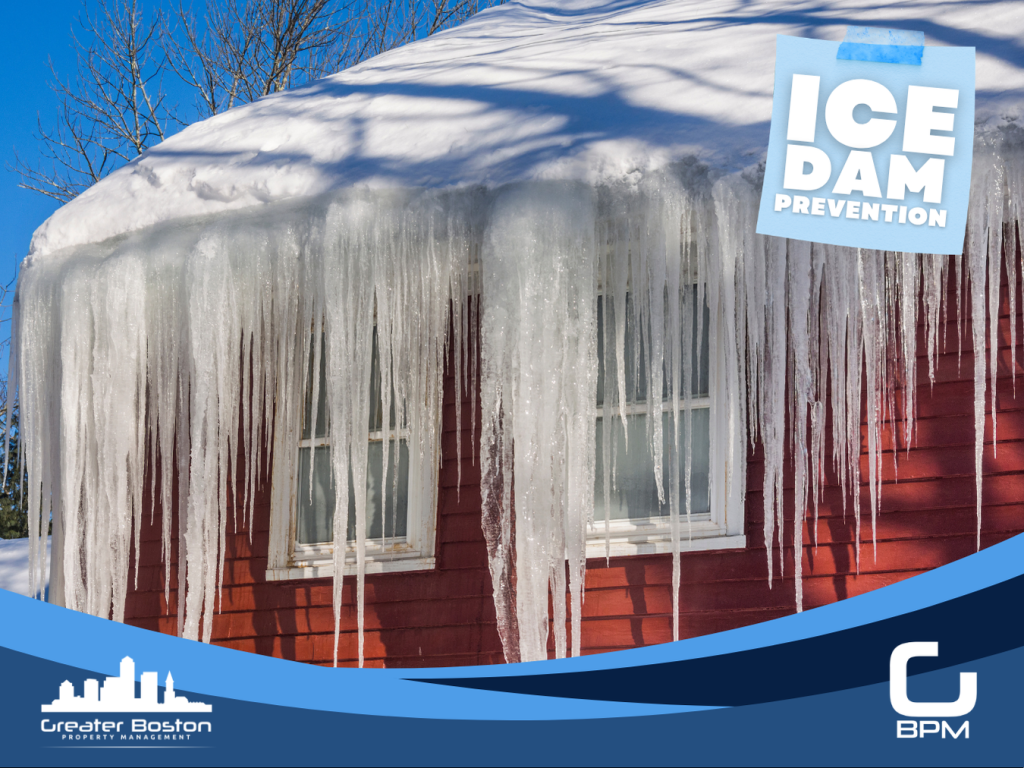
An ice dam is a ridge of ice at the roof edge that blocks meltwater from draining. Water pools behind it, backs up under the shingles, and enters the building.
The Mechanism
Snow sits on the roof. Heat escaping from the building warms the roof deck from below, and the snow directly above that warm surface melts — even on a day when the outdoor temperature never rises above freezing.
That meltwater runs down the roof until it reaches the eave, which overhangs unheated space and stays at outdoor temperature. There the water refreezes. Repeat this cycle over several days and the ice at the eave builds into a dam.
Once the dam is tall enough, water pools behind it. Standing water on a sloped roof finds the laps between shingles, works upward by capillary action, and enters the roof assembly.
Why Boston Is Especially Prone
Three regional factors combine.
The temperature band is ideal. Ice dams form most reliably when outdoor temperatures sit in the 20s — cold enough to refreeze meltwater at the eave, warm enough that the heated roof deck above still melts snow. Boston spends much of January and February in exactly that band.
The building stock leaks heat. Boston’s housing is old. Much of the condo inventory occupies structures built before insulation standards existed, later converted to multiple units. Air sealing between heated space and the roof assembly is frequently poor or absent.
Roof geometry compounds it. Dormers, valleys, complex rooflines, and flat-to-pitched transitions — all common in Boston’s Victorian and triple-decker stock — create spots where snow accumulates and drainage is restricted. Those are the locations where dams start.
✅ The key insight: An ice dam is a heat-loss problem that presents as a roofing problem. Boards that treat it as roofing — by replacing shingles or adding gutters — spend money without changing the outcome.
Section 2: The Three Conditions That Produce Every Ice Dam
Remove any one of these and dams largely stop forming. Boston buildings frequently have all three.
Condition 1: Heat Escaping Into the Roof Assembly
Warm air leaks from heated space into the attic or roof cavity through every penetration: recessed light fixtures, attic hatches, plumbing and electrical penetrations, chimney chases, bath fan housings, and the top plates of interior walls.
This is air movement, not conduction — and air carries far more heat than conduction through insulation. Consequently, air leakage is the dominant heat source warming the roof deck in most Boston buildings.
Condition 2: Inadequate or Compressed Insulation
Insulation slows conductive heat transfer from the heated space below. Where it is thin, missing, or compressed — particularly at the eaves, where roof framing narrows — heat passes through readily.
In Boston’s older buildings, the eave is almost always the weak point. Insulation gets compressed into the narrowing cavity, or it was never installed that far out to begin with. That is precisely where the dam forms.
Condition 3: Inadequate Roof Ventilation
Ventilation moves outside air through the roof cavity, carrying away any heat that does escape and keeping the roof deck closer to outdoor temperature.
The system requires intake at the soffit and exhaust at the ridge. In practice, the most common failure in Boston buildings is insulation blocking the soffit vents — which eliminates intake entirely and renders ridge venting useless.
Section 3: What Actually Prevents Ice Dams — Ranked by Effectiveness
Not all interventions are equal. These are ordered by impact per dollar.
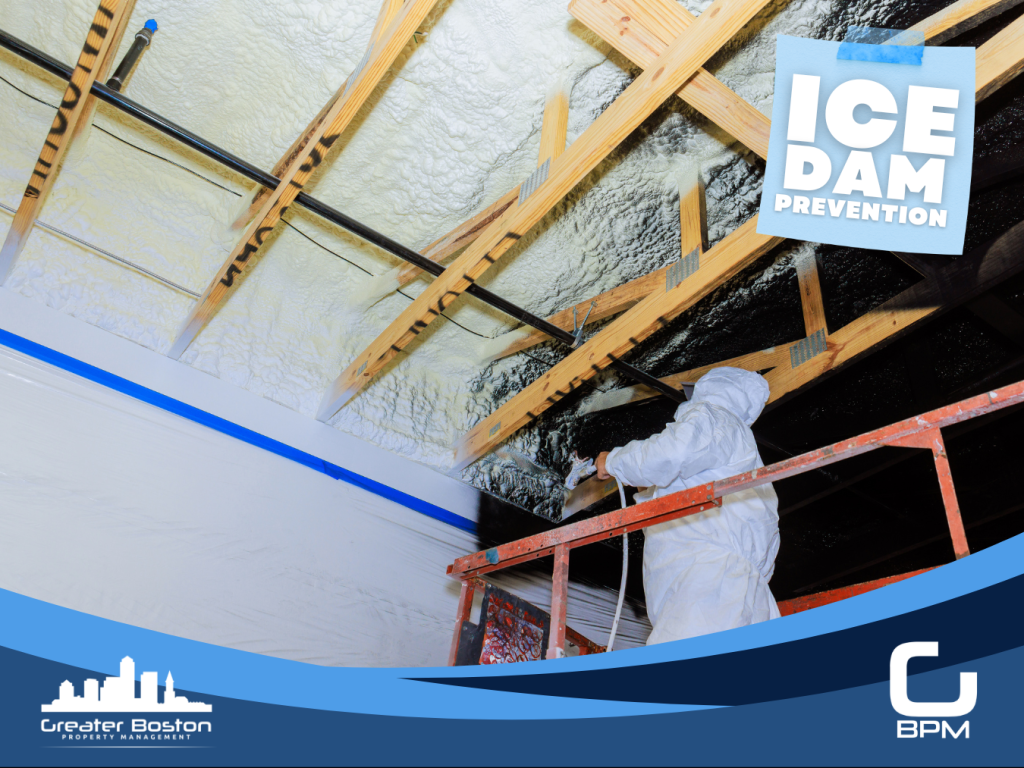
1. Air Sealing the Attic Floor — Highest Value by a Wide Margin
Sealing the penetrations between heated space and the roof cavity addresses the dominant heat source. This is the single most effective ice dam intervention available, and it is usually the cheapest.
What to seal: recessed light housings (with fire-rated covers where required), attic hatch perimeter and the hatch itself, plumbing vent penetrations, electrical wire penetrations, chimney chase gaps with fire-rated material, bath and kitchen fan housings and ducts, and the top plates of interior partition walls.
A Boston-specific note: in converted buildings, the gap where an original chimney passes through the attic is frequently large, unsealed, and the single biggest air leak in the structure.
2. Correcting Insulation at the Eaves
Once air sealing is complete, insulation does its job. Priority is the eave — the first four feet from the roof edge — where coverage is most often deficient.
Install baffles to hold insulation back from the soffit vents while maintaining the airflow channel. Then bring insulation to full depth across the entire attic floor, not just the accessible middle.
3. Restoring Soffit-to-Ridge Ventilation
Confirm soffit vents are clear and that baffles maintain an open channel from soffit to ridge. Verify ridge venting is unobstructed and actually continuous.
Ventilation alone does not prevent ice dams — it supports the first two measures. A well-ventilated roof over a leaky, under-insulated ceiling will still form dams.
4. Clearing Gutters and Roof Drains
Clear drainage does not prevent the dam from forming, but it gives meltwater somewhere to go and reduces how much water sits against the roof edge.
In Boston this requires two clearings: one after the first leaf drop in October, and a second after full drop in November. Boards that clear once in October consistently leave the debris that actually blocks drainage when ice forms.
5. Ice and Water Shield at the Eaves — During Roof Replacement Only
A self-adhering membrane beneath the shingles at the eave does not prevent dams. It prevents the water that backs up behind one from entering the building.
This is a worthwhile specification during any roof replacement, and Massachusetts building code requires it in this climate zone. It is not a retrofit, and it is not a substitute for addressing heat loss.
🔗 Related reading → The Complete Boston Fall Maintenance Guide
Section 4: What Does Not Prevent Ice Dams (But Gets Sold Anyway)
Boards spend real money on measures that do not address the cause. These are the common ones.
Heated Cables Along the Eave
Heat cables melt a channel through the ice so water can drain. They are a symptom management tool, not a prevention measure.
They consume electricity continuously through the season, they fail and require replacement, and they do nothing about the heat loss creating the dam. Where a building has a persistent problem and the structural fix is genuinely impractical, cables have a place — but they should never be the first intervention.
Gutter Guards
Gutter guards keep leaves out. They have no effect on ice dam formation, and in some configurations they make ice accumulation at the eave worse.
Roof Raking After Every Storm
Removing snow reduces the material available to melt, which helps marginally. However, raking is labor-intensive, must be repeated after every storm, carries real injury risk, and frequently damages shingles.
It is a reasonable emergency measure during an active problem. It is not a prevention strategy.
Replacing the Roof
A new roof over an unchanged, leaky, under-insulated ceiling will form ice dams exactly as the old one did. If the roof genuinely needs replacement, specify ice and water shield at the eaves and address the attic at the same time — but roof replacement alone does not solve this.
⚠️ The pattern to watch for: a contractor who proposes heat cables or a roof replacement without inspecting the attic has not diagnosed the problem. Ask what they found in the attic. If they did not go up, get another opinion.
Section 5: The Fall Intervention Sequence — September Through November
September: Inspect and Diagnose
Get into the attic or roof cavity and document conditions with photographs. Record insulation depth and coverage, particularly at the eaves. Identify every air leak — recessed lights, hatch, chimney chase, plumbing penetrations, fan housings. Confirm whether soffit vents are clear or blocked by insulation.
Also useful: photograph last winter’s ice dam locations if anyone recorded them, or identify them from staining on interior ceilings. Dams recur in the same places.
September–October: Air Seal and Insulate
Schedule the air sealing and insulation work. This is interior work and not temperature-dependent in the way exterior work is, but contractor availability tightens through the fall.
Confirm the scope includes baffles at the eaves to maintain the ventilation channel, and that recessed lighting is handled with appropriate fire-rated covers.
October: First Gutter and Roof Drain Clearing
After the first significant leaf drop. Include roof drains and scuppers on any flat sections.
November: Second Clearing After Full Leaf Drop
This is the one that matters. Boston’s leaf drop extends into November, and the debris falling after the October clearing is what blocks drainage when ice forms.
November: Document Everything
Photograph the completed attic work with dates. Record the gutter clearing dates. File it all permanently.
Insurers examine maintenance history when adjusting ice dam claims, and documented preventive work materially strengthens the association’s position.
🔗 Related reading → Heating System Prep for Boston Condo Buildings

Section 6: What an Ice Dam Actually Costs a Boston Condo Association
The Direct Water Damage
Water entering at the eave travels along framing before it appears, so damage is rarely confined to one unit. A single dam commonly affects the top-floor unit, the ceiling below it, and shared wall cavities between them.
Typical Boston condo ice dam claims run $8,000 to $40,000. Severe events involving multiple dams or extended intrusion exceed that substantially.
The Mold Remediation That Follows
Water inside a wall or ceiling cavity in winter does not dry. It sits until spring, and by April the association is dealing with a mold remediation scope on top of the original water damage.
This is frequently the larger of the two costs, and it is the one boards do not anticipate in February.
The Emergency Response Premium
Ice dam removal during an active event is specialized, urgent work performed at height in hazardous conditions. Steam removal — the only method that does not damage roofing — commands premium rates during the storms when everyone needs it simultaneously.
The Insurance Consequence
Ice dam claims affect the association’s loss history and premium at renewal. Repeat claims at the same building can affect insurability.
Furthermore, insurers increasingly scrutinize whether reasonable preventive maintenance occurred. An association that cannot produce records of attic inspection, air sealing, or gutter clearing is in a weaker claim position.
The Unit Owner Dispute
Ice dam damage crosses the boundary between common elements and unit interiors, which means the association and the owner frequently disagree about who is responsible for what. Those disputes consume trustee time and occasionally attorney time.
Clear documentation of the cause and of the association’s preventive efforts shortens them considerably.
Section 7: How Condo Management Companies in Boston Handle Ice Dam Prevention
Diagnosis Happens in the Attic, Not From the Ground
Professional condo management companies in Boston inspect the roof cavity as a standard fall item rather than responding to dams after they appear. The conditions that produce them — air leakage, eave insulation, blocked soffits — are only visible from inside.
Dam Locations Are Tracked Year Over Year
Dams recur in the same spots. A management company records where they formed, what was done about it, and whether the intervention held. Self-managed associations rediscover the same locations each winter.
The Work Is Scoped Correctly
Specifying air sealing before insulation, baffles before blowing more material in, and fire-rated covers over recessed lights is the difference between work that fixes the problem and work that merely costs money.
Two Gutter Clearings Are Scheduled, Not One
The November clearing after full leaf drop is the one most boards skip. It is a standing calendar item for professionally managed properties.
Documentation Supports the Claim
Attic inspection photographs, air sealing invoices, insulation specifications, and dated gutter clearing records all exist in one place when an insurer asks.
🔗 Related reading → How to Choose a Condo Management Company in Boston
Frequently Asked Questions
Ice dams form when heat escaping from the building warms the roof deck, melting snow above it. That meltwater runs down to the eave — which overhangs unheated space and stays at outdoor temperature — and refreezes there. Over several freeze-thaw cycles the ice builds into a dam that blocks drainage, and water pools behind it until it works under the shingles. The root cause is heat loss, not roofing.
Air sealing the attic floor. Warm air leaking through recessed lights, attic hatches, plumbing penetrations, and chimney chases carries far more heat into the roof cavity than conduction through insulation does. Sealing those penetrations addresses the dominant heat source and is usually the cheapest intervention available. Insulation and ventilation improvements follow, but they work best after air sealing is complete.
No. Heat cables melt a drainage channel through ice that has already formed — they manage the symptom rather than preventing the cause. They also consume electricity continuously, require periodic replacement, and do nothing about the heat loss creating the dam. They have a legitimate place where a structural fix is genuinely impractical, but they should never be the first intervention a board considers.
Not by itself. A new roof over an unchanged, leaky, under-insulated ceiling will form dams exactly as the old roof did. If replacement is genuinely needed, specify ice and water shield at the eaves — Massachusetts code requires it in this climate zone — and address the attic air sealing and insulation at the same time. The membrane prevents water intrusion; it does not prevent the dam.
Typical claims run $8,000 to $40,000, with severe events exceeding that. The direct water damage is often the smaller portion — mold remediation following water trapped in wall and ceiling cavities over winter frequently costs more, and surfaces in spring. Emergency steam removal during an active event commands premium rates, and repeat claims affect the association’s premium and insurability at renewal.
September for inspection and diagnosis, September through October for air sealing and insulation work, October for the first gutter clearing, and November for the second clearing after full leaf drop. The entire sequence must be complete before the first significant snowfall. Work scheduled in December is reactive and substantially more expensive.
Conclusion
Ice dams are the clearest example of a Boston maintenance problem where the diagnosis and the intervention sit in completely different places from the symptom.
The water appears on an interior wall in February. The cause is a gap around a chimney chase and four feet of missing insulation at the eave. The fix costs a fraction of the remediation, and it has to happen in September.
Boards that understand this get into the attic in the fall, seal the leaks, correct the insulation, clear the gutters twice, and document all of it. Boards that do not replace the shingles, install heat cables, and have the same conversation again the following February.
Get into the attic. That is where this problem actually lives.
📥 Free Resource: Boston Condo Ice Dam Prevention Guide
Download the full field guide — attic inspection worksheet, air leak location map, insulation and ventilation specifications, two-clearing gutter schedule, and a contractor scoping checklist.
[Download the Free Ice Dam Prevention Guide (PDF) →]
Includes the attic air leak checklist specific to Boston’s converted building stock.
Find the Problem Before February Does
Greater Boston Property Management inspects roof cavities as a standard fall item, tracks recurring dam locations year over year, and scopes air sealing and insulation work correctly — before the first snow.
[Request a Free Fall Building Review →]
No obligation. We will inspect the attic, identify the air leaks, and tell you what actually needs doing.
Continue Reading: The Boston Fall Maintenance Series
- ← Series hub: The Complete Boston Fall Maintenance Guide
- ← Previous: Heating System Prep for Boston Condo Buildings
- → Next: The Complete Boston Condo Winterization Guide
- ← Evergreen: Condo Management in Boston: What Every Landlord Needs to Know