
Table of Contents
- Winterization Is a Deadline, Not a Task
- Irrigation Systems: The Most Common Boston Freeze Loss
- Pool and Amenity Winterization
- Building Water Systems and Exterior Fixtures
- The Shutoff Problem Almost Every Board Has
- Site and Exterior Winterization
- What Freeze Damage Actually Costs a Boston Association
- How Condominium Management Companies in Boston Run Winterization
- Frequently Asked Questions
Introduction
Most fall maintenance tasks tolerate slipping a week. Winterization does not. Boston’s first hard frost arrives mid-to-late October, and every water-bearing system outside the building envelope must be purged before it.
This is why condominium management companies in Boston treat October as a hard deadline rather than a planning window. A missed irrigation blow-out does not produce a problem in October. It produces cracked PVC discovered in April, split heads across a dozen zones, and a repair bill many times the cost of the service that was skipped.
This guide covers every system that needs attention, in the order it needs it, with the Boston-specific details that determine whether the work actually holds.
📊 Quick Stats: Boston Winterization
| Factor | Detail |
| Boston’s typical first hard frost | Mid-to-late October |
| Irrigation blow-out booking deadline | September 15 |
| Frozen pipe claim range | 5,000–25,000 |
| Spring irrigation repair vs. winterization cost | Routinely 5–10× |
| Most common freeze location | Piping in exterior wall cavities and unheated attic spaces |
| Required pressure for irrigation blow-out | Typically 50–80 PSI, never exceeding system rating |
| Pool chemical handling | Per MA Board of Health requirements |

Section 1: Winterization Is a Deadline, Not a Task
The distinction matters operationally. Tasks get scheduled when convenient. Deadlines get scheduled backward from a fixed date.
The Fixed Date Is Set by Weather
Boston’s first hard frost — a sustained drop below 28°F — typically arrives between October 15 and the end of the month. Some years it comes earlier. No year does it come later enough to make November winterization safe.
Consequently, the entire sequence must complete before a date that nobody controls and that varies by roughly two weeks year to year. The only safe approach is to finish by mid-October.
Booking Happens a Month Before the Work
Irrigation and pool winterization contractors in Greater Boston fill their October calendars through September. An association calling in early October is asking for an appointment in a window that is already allocated.
Book both services by September 15. The work happens in October; the booking closes in September.
Partial Winterization Is Not Winterization
A system is either fully purged or it is not. Water remaining in one zone, one valve, or one exterior fixture freezes exactly as readily as water throughout the system.
Furthermore, partial work creates false confidence. Boards that believe the building is winterized stop checking, which means the one missed component goes unnoticed until it fails.
✅ The operating rule: Work backward from October 15. Book by September 15, execute in the first two weeks of October, and verify completion before the end of the month.
Section 2: Irrigation Systems — The Most Common Boston Freeze Loss
Irrigation is where most Boston associations lose money to freeze damage, because the failure is invisible until spring.
What a Proper Blow-Out Involves
A contractor connects an air compressor to the system and forces water out of every line, valve, and head using compressed air.
The scope should specify:
- Every zone blown out individually, not the system as a whole
- Compressed air pressure appropriate to the pipe material, typically 50 to 80 PSI and never exceeding the system rating
- Backflow preventer drained and insulated, or removed and stored
- Controller shut down and, where applicable, the backup battery removed
- Main supply valve to the irrigation system closed
- Written confirmation of the service with the date
Why Zone-by-Zone Matters
Blowing the system as a whole leaves water in zones with higher elevation or longer runs. Those zones crack. The contractor who works zone by zone takes longer and charges slightly more, and the difference shows up as the absence of a spring repair bill.
Ask directly how many zones the building has and confirm the contractor’s quote reflects that count.
The Backflow Preventer
Backflow preventers sit above grade, contain water, and are among the most expensive single components in the system. A cracked backflow assembly routinely costs more than the entire winterization service.
Confirm the scope includes draining and insulating it, or removing and storing it indoors.
What Spring Looks Like Without It
Water expands roughly nine percent when it freezes. In a sealed PVC line that expansion has nowhere to go, so the pipe splits. Heads crack at the riser. Valve bodies fracture.
None of this is visible until the system is pressurised in April — at which point the association is paying for excavation, pipe replacement, head replacement, and a delayed landscaping season.
🔗 Related reading → Book Now, Save Later: Fall Vendor Booking in August
Section 3: Pool and Amenity Winterization
For associations with pools, closing is a regulated process as much as a maintenance one.
The Closing Sequence
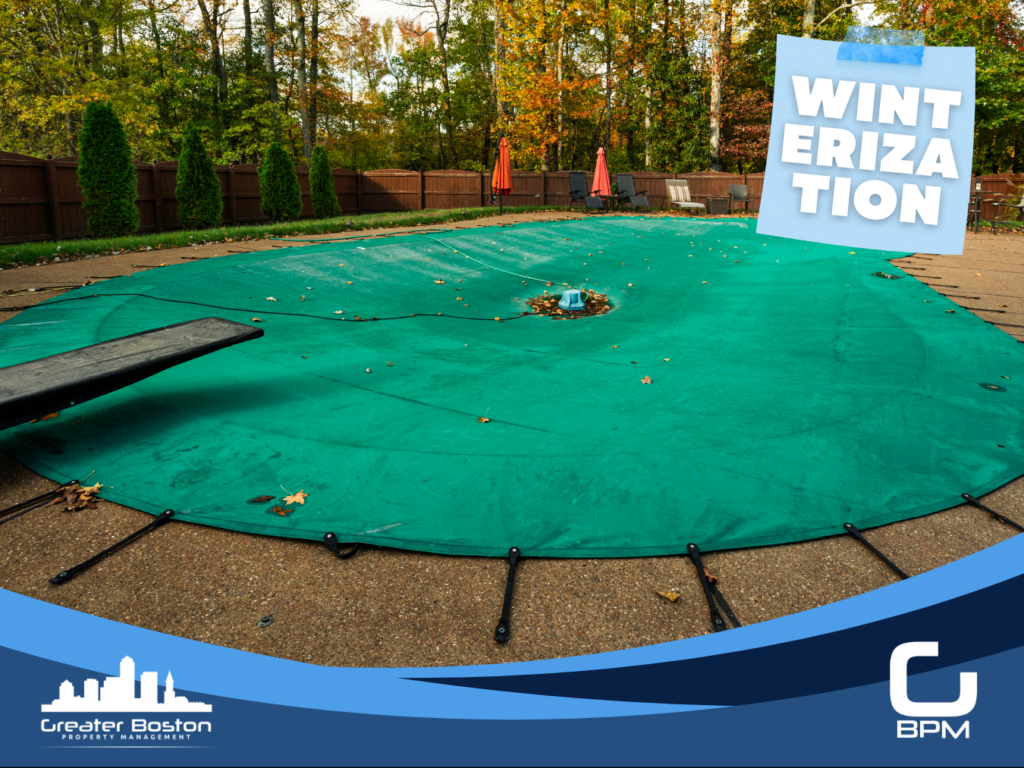
Balance the water chemistry before closing. Water sitting all winter at incorrect pH or alkalinity stains and etches surfaces, producing a spring opening that costs considerably more.
Lower the water level to the manufacturer-specified depth below the skimmer, where applicable to your pool type.
Drain all equipment — pump, filter, heater, chlorinator. Any water remaining in a pump housing or heater core freezes and cracks the component.
Blow out the plumbing lines and plug the returns. This is the same principle as irrigation and the same consequence if skipped.
Install the cover correctly and secured. A cover that fails mid-winter fills the pool with debris and meltwater.
Store or dispose of pool chemicals per Massachusetts Board of Health requirements. Chemicals left in an unheated space degrade, and some combinations present genuine hazards.
The Communication Piece
Residents need advance notice of the closing date. The board cannot provide that until the service is confirmed — which is another reason the September booking deadline matters.
Send the notice at least two weeks before closing, and include the anticipated spring opening date if known.
Other Amenities
Any outdoor amenity with water or exposed mechanicals needs the same consideration: fountains, splash features, outdoor showers, irrigation at planters, and any exterior sink or bar.
These get missed because they are small. They crack the same way.
Section 4: Building Water Systems and Exterior Fixtures
Beyond the seasonal systems, the building’s own plumbing needs attention before winter.
Exterior Hose Bibs
Every exterior hose bib needs its interior shutoff closed and the exterior valve opened to drain. Remove and store all hoses — a hose left attached traps water in the bib regardless of the shutoff.
Frost-free sillcocks require specific attention. They are designed to drain automatically, but only if the hose is disconnected and the fixture is pitched correctly. A frost-free sillcock with a hose attached freezes and splits inside the wall, where the leak is invisible until spring thaw.
Piping in Unheated and Marginally Heated Spaces
This is where the serious losses happen. Any pipe running through a crawl space, unheated stairwell, garage ceiling, exterior wall cavity, or attic knee wall is a freeze candidate.
Confirm before winter:
- Pipe insulation is present, continuous, and intact — not gapped at joints and elbows
- Heat trace cable, where installed, is functional and tested before it is needed
- The space itself is sealed against cold air infiltration at rim joists, foundation penetrations, and vents
Test heat trace in October, not December. A cable that failed over the summer provides no protection, and there is no indicator that tells you until the pipe it protects has frozen.
Vacant and Seasonal Units
Boston condo buildings frequently have units that sit vacant through winter — owners who travel, units between sales, or seasonal residents.
A unit with the heat turned down to 45°F to save money is a unit whose exterior-wall plumbing is at genuine risk. Associations should establish a minimum interior temperature in the governing documents or rules, and should confirm compliance for known-vacant units before winter.
🔗 Related reading → Heating System Prep for Boston Condo Buildings
Section 5: The Shutoff Problem Almost Every Board Has
This section covers a failure that is not about equipment at all.
The Scenario
A pipe bursts at 2 a.m. in February. Water is coming through a ceiling. The trustee on call arrives and does not know where the main shutoff is, or the zone shutoff for that stack, or whether the valve even works.
Every minute of that delay is additional water. The difference between a four-minute response and a forty-minute response is frequently the difference between a $4,000 claim and a $25,000 one.
What to Confirm Before Winter
Locate every shutoff — building main, zone or riser shutoffs, irrigation main, and any isolation valves for mechanical equipment.
Photograph each one with a wider shot showing how to find it and a close shot showing the valve itself.
Confirm each valve actually operates. Valves that have not been exercised in years seize. A shutoff that will not close is not a shutoff.
Label them clearly and durably. Handwritten tape falls off.
Distribute the locations to at least two trustees and your management company, plus the after-hours contact.
The Access Problem
A shutoff behind a locked door that only one trustee can open is functionally unavailable at 2 a.m. Confirm access as carefully as location — key availability, lockbox codes, and whether the path to the valve is clear of stored material.
⚠️ Worth doing this week: Walk the building and photograph every shutoff. It takes under an hour and it is the single highest-value hour of winter preparation most boards never spend.
Section 6: Site and Exterior Winterization
The grounds need preparation too, and several items have freeze implications of their own.
Drainage Before Freeze
Clear every catch basin, area drain, and trench drain before winter. A blocked drain produces standing water, standing water becomes ice, and ice at a building entrance or in a parking area is a slip-and-fall exposure through the entire season.
Confirm downspout extensions still direct water away from the foundation, and that discharge points will not create an ice sheet across a walkway.
Walkway and Entry Preparation
Inspect all walkways, stairs, and entries for trip hazards and surface deterioration before snow covers them. A cracked step is a hazard in October and an invisible hazard in January.
Confirm handrails are secure. Handrail failures spike in winter when people grab them to catch themselves.
Irrigation Heads Near Walkways
Mark or map irrigation heads adjacent to plowed areas. Snow removal equipment destroys heads that nobody flagged, and the damage is discovered in spring alongside the freeze damage.
This is a five-minute conversation with the snow contractor that prevents a recurring annual cost.
Outdoor Furniture and Equipment
Store or secure anything that wind can move. Confirm any seasonal equipment — pool furniture, planters, bike racks if removable — is stored where it will not be damaged or obstruct snow removal.
Section 7: What Freeze Damage Actually Costs a Boston Association
The Burst Pipe
A frozen pipe does not leak gradually. It splits, and when the ice thaws it releases water at full supply pressure until someone closes a valve.
A burst supply line in an upper-floor unit sends water through every floor below it. Typical Boston condo frozen pipe claims run $5,000 to $25,000, and multi-unit water damage exceeds that substantially.
The Irrigation Rebuild
Spring irrigation repair after a missed blow-out routinely costs five to ten times the winterization service. Excavation to reach cracked lines, pipe replacement, head replacement, and valve work compound quickly across a multi-zone system.
The Pool Reopening Penalty
A pool closed without proper chemistry balancing or equipment drainage opens in spring with staining, etching, or a cracked pump or heater. Equipment replacement in particular turns a routine opening into a capital expense.
The Deductible and Premium Effect
Freeze claims affect the association’s loss history. Repeat claims affect premium at renewal and, in persistent cases, insurability.
Additionally, insurers examine whether reasonable preventive steps occurred. Documented winterization records materially strengthen the association’s position on a freeze claim.
The Liability Exposure
Where a freeze event damages a unit owner’s property, the question of responsibility between the association and the owner surfaces immediately. Documented evidence that the association completed winterization properly shortens those disputes considerably.
Section 8: How Condominium Management Companies in Boston Run Winterization
The Calendar Runs Backward From the Frost Date
Professional condominium management companies in Boston schedule winterization against October 15 rather than against convenience. Bookings are placed in August and early September across the portfolio, before contractor calendars allocate.
Scope Is Specified, Not Assumed
Zone-by-zone irrigation blow-out, backflow preventer handling, equipment drainage on pool systems, and written service confirmation are all specified in the work order rather than left to whatever the contractor’s standard visit includes.
Shutoff Maps Are Maintained
Valve locations, photographs, operating condition, and access requirements are documented and available to the after-hours contact — not held in one trustee’s memory.
Heat Trace Is Tested in October
Because it is a line item on a seasonal checklist rather than something someone thinks of in December.
Vacant Unit Temperatures Are Tracked
Known-vacant units are identified before winter and minimum interior temperature is confirmed with the owner, in writing.
Documentation Supports the Claim
Service confirmations, dated photographs, and completion records exist in one place when an insurer asks what preventive work was done.
🔗 Related reading → How to Choose a Condo Management Company in Boston
Frequently Asked Questions
Complete all winterization by October 15. Boston’s first hard frost typically arrives between mid-October and the end of the month, and it varies by roughly two weeks year to year. Book irrigation and pool winterization by September 15 — contractors fill their October calendars through September, so an association calling in early October is asking for an already-allocated appointment.
Every zone blown out individually rather than the system as a whole, compressed air at a pressure appropriate to the pipe material (typically 50 to 80 PSI, never exceeding system rating), the backflow preventer drained and insulated or removed and stored, the controller shut down, the main irrigation supply valve closed, and written confirmation of the service with the date. Zone-by-zone matters because a whole-system blow leaves water in higher or longer runs.
Frost-free sillcocks drain automatically only if the hose is disconnected and the fixture is pitched correctly. A hose left attached traps water inside the bib, which then freezes and splits within the wall cavity — where the leak stays invisible until spring thaw. Disconnect and store every hose, and confirm the interior shutoff is closed and the exterior valve opened to drain.
Most Boston associations set a minimum interior temperature in the governing documents or rules, commonly in the 55 to 60°F range. A unit turned down to 45°F to save money puts exterior-wall plumbing at genuine freeze risk, and the resulting damage affects neighbouring units as well. Identify known-vacant units before winter and confirm compliance with the owner in writing.
Frozen pipe claims typically run $5,000 to $25,000, with multi-unit water damage from an upper-floor burst exceeding that substantially. Spring irrigation repair after a missed blow-out routinely costs five to ten times the winterization service. Beyond direct cost, freeze claims affect loss history, premium at renewal, and in persistent cases insurability.
Knowing where the shutoffs are and confirming they operate. A burst pipe at 2 a.m. where the responding trustee cannot locate or close the valve turns a manageable loss into a major one — the difference between a four-minute and a forty-minute response is frequently the difference between a $4,000 and a $25,000 claim. Photograph every shutoff, confirm each valve actually closes, label them durably, and distribute the locations.
Conclusion
Winterization is the most deadline-driven work on the Boston property calendar. There is no partial credit and no late option — the frost arrives when it arrives, and every system either got purged or did not.
The sequence is not complicated. Book irrigation and pool service by September 15. Execute in the first two weeks of October. Drain the hose bibs, confirm the pipe insulation and heat trace, clear the drains, and check the vacant units.
Then walk the building and photograph every shutoff, because the one thing you cannot winterize against is a pipe that bursts anyway — and the only variable you control at that point is how fast someone can close the valve.
📥 Free Resource: Boston Condo Winterization Checklist
Download the complete checklist — irrigation and pool scope specifications, building water system walkthrough, shutoff location log, vacant unit tracker, and site preparation items.
[Download the Free Winterization Checklist (PDF) →]
Includes the shutoff mapping worksheet most boards have never completed.
Is Every System Purged Before the Frost?
Greater Boston Property Management schedules winterization against the frost date rather than convenience, specifies the scope rather than accepting a standard visit, and maintains shutoff maps available to the after-hours contact.
[Request a Free Winterization Review →]
No obligation. We will review what is scheduled, what is missing, and whether your shutoffs are documented.
Continue Reading: The Boston Fall Maintenance Series
- ← Series hub: The Complete Boston Fall Maintenance Guide
- ← Previous: Ice Dam Prevention: The Boston Condo Guide
- → Next: Snow Removal Contracts for Boston Condo and HOA Boards
- ← Heating System Prep for Boston Condo Buildings
- ← Evergreen: Condo Management in Boston: What Every Landlord Needs to Know