
Table of Contents
- How Boston’s Summer Heat and Humidity Damage Condo Buildings
- HVAC and Cooling System Priorities for Boston Condominium Management
- Flat Roof and Membrane Inspection — The Priority Most Trustees Ignore
- Water Intrusion and Moisture Control in Boston Summer
- Masonry, Facade, and Thermal Movement Damage
- How Condominium Management Companies in Boston Handle Summer Building Stress
- Frequently Asked Questions
Introduction
Boston’s winters get all the attention. Ice dams, frozen pipes, roof collapses under snow load — these are the seasonal threats every condo trustee learns to fear. But summer damages Boston condo buildings just as severely, and it does so far more quietly.
Effective condominium management in Boston means understanding that summer heat, humidity, and UV exposure do not announce themselves the way a burst pipe does. They degrade roofing membranes, stress mechanical systems, drive moisture into building envelopes, and open thermal movement gaps in masonry — all invisibly, over weeks, until fall rain arrives and reveals what summer quietly broke.
This guide covers exactly what Boston’s summer climate does to condo buildings, and what needs to be inspected, serviced, and documented before the season ends.
📊 Quick Stats: Boston Summer Building Stress
| Stat | Detail |
| Peak flat roof surface temperature | 150–170°F on a 90°F Boston day |
| Boston July 2026 average high | 82–88°F, heat index frequently over 95°F |
| Typical Boston summer humidity | 65–80% relative humidity |
| Thermal expansion on a 60-ft brick facade | Roughly 0.25–0.40 inches between winter and summer |
| #1 summer emergency in Boston condos | HVAC failure during heat advisories |
| Most under-inspected building component | Flat roof membrane and flashing seams |

Section 1: How Boston’s Summer Heat and Humidity Damage Condo Buildings
Boston’s summer climate combines three stressors that most building materials handle poorly together: sustained high heat, high relative humidity, and intense UV exposure. Understanding how each one attacks your building explains why summer maintenance is not optional.
Heat: The Thermal Cycling Problem
Every Boston summer day puts your building through a thermal cycle. Surfaces heat dramatically through the afternoon and cool overnight. Consequently, materials expand and contract repeatedly — and over hundreds of cycles per season, that movement fatigues joints, seals, fasteners, and adhesives.
The effect is most severe on dark, exposed surfaces. A black EPDM flat roof on a Back Bay brownstone reaches 150–170°F on a 90°F afternoon. That temperature accelerates the chemical breakdown of the membrane, softens adhesives at seams, and drives thermal movement that pulls flashing away from parapet walls.
Humidity: The Moisture Migration Problem
Boston summers routinely run 65–80% relative humidity. That humid outdoor air enters building envelopes through every gap — unsealed windows, failed caulking, foundation penetrations, and ventilation openings.
When that warm, humid air contacts cooler interior surfaces — air-conditioned hallways, basement walls, cold water pipes — condensation forms. Over a full summer, that condensation supports mold growth in wall cavities, degrades insulation performance, and stains interior finishes in ways that residents notice and report.
Furthermore, Boston’s older housing stock was built without vapor barriers. As a result, moisture that enters an 1890s brick wall assembly has no engineered path out. It sits, and it does damage.
UV Exposure: The Material Degradation Problem
Ultraviolet radiation breaks down polymers. Specifically, UV exposure degrades roofing membranes, sealants, caulking, gaskets, plastic components, and painted surfaces — continuously, all summer, on every south- and west-facing surface of your building.
Sealant that was flexible and adhered in April becomes brittle and cracked by September on the sunniest elevations. Therefore, the caulking inspection that seemed adequate in spring frequently needs revisiting before fall.
✅ The core point: Winter damage in Boston is dramatic and immediately visible. Summer damage is gradual and invisible until it isn’t. This is precisely why proactive condominium management in Boston treats summer inspection as seriously as winter emergency response.
Section 2: HVAC and Cooling System Priorities for Boston Condominium Management
HVAC failure during a Boston heat advisory is the single most disruptive summer emergency a condo association faces. It is also, in the overwhelming majority of cases, entirely preventable.
Central Cooling System Service Requirements
Any central air conditioning, rooftop unit, or ductless mini-split system serving common areas requires professional service before the season’s first sustained heat event. A complete service visit covers:
- Refrigerant level check and leak detection
- Condenser and evaporator coil cleaning — dirty coils reduce efficiency dramatically and drive compressor failure
- Filter replacement throughout the system
- Electrical connection inspection and tightening — loose connections are a leading cause of mid-summer failures
- Thermostat calibration and programming verification
- Condensate drain and pan clearing — a blocked condensate line causes water damage, not just cooling loss
Licensing requirement: Any work involving refrigerant handling requires an EPA Section 608 certified technician. Verify certification before authorizing work, and confirm the contractor’s Massachusetts license at mass.gov/how-to/check-an-occupational-board-license.
The Condensate Drain Problem Boston Trustees Underestimate
In Boston’s humid summers, a central cooling system removes a significant volume of water from the air — often 5 to 20 gallons per day in a mid-sized building. That water exits through the condensate drain line.
When that line clogs with biological growth — which happens routinely in humid conditions — water backs up into the drain pan and overflows. Consequently, what began as a maintenance oversight becomes a water damage claim affecting ceilings, walls, and potentially multiple units below the mechanical space.
The fix is simple and cheap: confirm the condensate line is clear at every service visit, and install a condensate overflow safety switch if the system does not already have one. A $75 switch prevents thousands of dollars in water damage.
Common Area Cooling and Resident Health Considerations
Boston condo buildings with elderly residents or residents with medical conditions face heightened responsibility during heat events. While Massachusetts does not impose a strict cooling mandate on condo associations the way it mandates heat in winter, associations still carry a general duty of care.
Practically, this means:
- Ensuring common area cooling is functional before heat advisories occur
- Maintaining a resident list flagging anyone who has disclosed a heat-sensitive medical condition
- Establishing a communication protocol for heat emergencies — knowing how to reach every resident quickly
- Identifying the nearest City of Boston cooling center and including it in heat advisory communications
🔗 City of Boston Heat Emergency Resources → boston.gov

Section 3: Flat Roof and Membrane Inspection — The Priority Most Trustees Ignore
If there is one summer inspection that Boston condo associations skip most consistently, it is the flat roof. This is unfortunate, because flat roofs are simultaneously the most heat-stressed component of a Boston building and the most expensive to replace prematurely.
Why Boston Flat Roofs Fail in Summer
Flat and low-slope roofs are extremely common on Boston’s Victorian and Edwardian residential buildings. Most are covered in EPDM rubber, modified bitumen, or TPO membrane — all of which degrade under sustained UV and heat exposure.
Summer failure modes specific to Boston flat roofs include:
Blistering. Trapped moisture beneath the membrane expands as the surface heats, lifting the membrane into blisters that eventually rupture.
Seam separation. Adhesive at membrane seams softens at high temperature. Combined with thermal movement, seams progressively pull apart — creating direct water entry paths that are invisible from below until a leak appears.
Flashing failure at penetrations. Every roof penetration — vent stacks, HVAC curbs, drains, skylights — has flashing that is subject to thermal movement. These are the most common leak origins on Boston flat roofs.
Ponding and drain blockage. Summer thunderstorms deliver heavy rain quickly. If roof drains are partially blocked by debris, water ponds — and standing water on a heat-degraded membrane accelerates failure dramatically.
What a Proper Summer Flat Roof Inspection Covers
Schedule a professional roof inspection in July or August — after the season’s peak heat has revealed weaknesses, but before fall rain arrives to exploit them.
- Walk the entire membrane surface, documenting all blisters, cracks, punctures, and worn areas with photographs
- Probe all seams for separation or adhesion loss
- Inspect flashing at every penetration and along all parapet walls
- Verify all roof drains and scuppers are completely clear
- Check for ponding evidence — staining, debris lines, or vegetation growth indicating standing water
- Inspect the underside of the roof deck from inside where accessible, looking for staining or moisture
Documentation matters: photograph everything and date the record. A documented annual roof inspection history dramatically strengthens both insurance claims and warranty claims when a failure eventually occurs.
⚠️ Trustee warning: Never walk a hot flat roof without contractor guidance. Membranes soften significantly at high temperature and foot traffic on a 160°F EPDM surface can cause permanent damage — turning an inspection into a repair.
Section 4: Water Intrusion and Moisture Control in Boston Summer
Summer water intrusion in Boston condo buildings comes from two directions simultaneously: outside humidity migrating in, and interior condensation forming on cooled surfaces. Both require attention.
Interior Humidity and Condensation Control
Common areas, basements, and mechanical spaces are where summer moisture problems concentrate in Boston buildings. Specifically, watch for:
Basement and foundation moisture. Boston’s high summer water table combined with humid air produces persistent basement dampness. Signs include efflorescence (white mineral deposits) on foundation walls, musty odors, and visible moisture on cold surfaces.
Cold water pipe condensation. Uninsulated cold water supply lines sweat heavily in humid conditions. Over a full summer, that continuous dripping can cause significant damage to ceilings, drywall, and stored materials.
Mechanical room humidity. Boiler rooms, laundry rooms, and mechanical spaces frequently lack adequate ventilation for summer conditions. Consequently, elevated humidity accelerates corrosion of equipment and creates conditions for mold growth.
Practical Moisture Control Actions
- Insulate all accessible cold water supply lines in unconditioned spaces — inexpensive foam pipe insulation eliminates condensation entirely
- Install and maintain a dehumidifier in persistently damp basements, targeting 50% relative humidity or below
- Verify all mechanical space exhaust ventilation is functional at peak summer temperature, not just at moderate temperatures
- Check that laundry room dryer vents are clear and vent fully to the exterior — a disconnected dryer vent releases enormous moisture volumes into the building
- Confirm all sump pumps operate correctly — test by manually raising the float, not just by visual inspection
Exterior Water Management During Summer Storms
Boston summer thunderstorms deliver intense rainfall in short bursts. That pattern overwhelms drainage systems that handle steady rain adequately.
Confirm before peak storm season:
- All gutters and downspouts are completely clear and securely attached
- Downspout extensions direct water at least 4 feet from the foundation
- Grading around the building slopes away from foundation walls
- Area drains and window well drains are clear
- Any basement window wells have functional covers
Section 5: Masonry, Facade, and Thermal Movement Damage
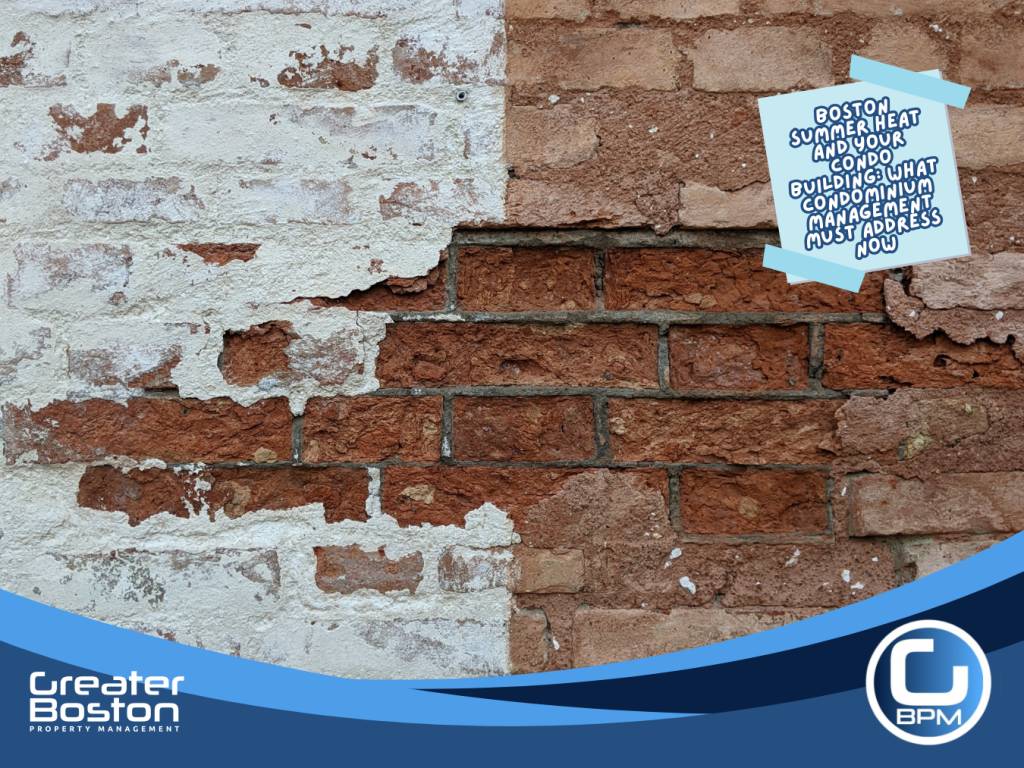
Boston’s masonry building stock — brick, brownstone, granite, limestone — is beautiful, durable, and specifically vulnerable to the thermal cycling that summer produces.
How Thermal Movement Damages Boston Masonry
A 60-foot brick facade expands roughly 0.25 to 0.40 inches between a Boston winter low and a summer high. Well-built masonry accommodates that movement through expansion joints and flexible sealants. However, much of Boston’s pre-1940 housing stock was built without engineered expansion joints — meaning the movement has to go somewhere.
Consequently, it concentrates at the weakest points: mortar joints, window and door surrounds, lintels, and parapet walls. Over decades of cycling, mortar crumbles, sealants fail, and cracks propagate.
What to Inspect on Boston Masonry in Summer
Summer is the correct season for masonry inspection and repair, because repointing and sealant work require warm, dry conditions with temperatures consistently above 50°F.
Mortar joints. Look for crumbling, powdery mortar, missing sections, and joints where you can insert a key more than a quarter inch. Note the pattern — vertical cracking through multiple courses indicates structural movement, not just weathering.
Window and door surround sealant. Sealant should be continuous, flexible, and adhered on both sides. Cracked, hardened, or separated sealant is a direct water entry path.
Lintels above openings. Steel lintels rust and expand — a process called rust jacking — which lifts and cracks the masonry above. Look for horizontal cracking directly above windows and doors, and for rust staining.
Parapet walls. These are the most exposed masonry on any Boston building, subject to weather on both faces. They are also the most common source of water entry at the roof line.
Efflorescence patterns. White mineral deposits on brick indicate water is moving through the masonry and evaporating at the surface. Map where it appears — the pattern points toward the water source.
The Historic District Consideration
Many Boston condo buildings in Back Bay, Beacon Hill, the South End, and Charlestown sit within local historic districts. Consequently, exterior masonry work — repointing, cleaning, sealant replacement, and any visible facade repair — frequently requires approval from the Boston Landmarks Commission or the relevant neighborhood architectural commission before work begins.
Build that approval timeline into your project schedule. Commission review adds weeks, and starting unapproved work in a historic district generates stop-work orders and potential fines.
🔗 Boston Landmarks Commission → boston.gov
Section 6: How Condominium Management Companies in Boston Handle Summer Building Stress
Understanding what summer does to a Boston condo building is one thing. Systematically inspecting, servicing, documenting, and budgeting for it every year is another. This is where professional condominium management in Boston delivers measurable technical value.
Seasonal Inspection Protocols That Actually Run
Professional management companies operate written seasonal inspection protocols — a defined checklist executed on a defined schedule, by a person whose job it is to execute it. Every summer, the same components get inspected, the same photographs get taken, and the same records get filed.
Self-managed associations inspect when someone notices something. Consequently, the components that fail invisibly — flat roof membranes, condensate lines, masonry sealant — are precisely the components self-management misses most consistently.
Technical Vendor Relationships
Diagnosing whether a flat roof blister requires immediate repair or annual monitoring is a technical judgment. So is deciding whether masonry cracking is weathering or structural movement. Professional condominium management companies in Boston maintain relationships with roofing consultants, structural engineers, and masonry restoration specialists who make those calls accurately.
Furthermore, those relationships mean a management company can obtain a qualified opinion quickly — often within days — rather than spending weeks finding a contractor willing to look at the problem at all during peak season.
Documentation That Supports Claims and Warranties
When a roof fails, the insurance and warranty questions are identical: was the roof properly maintained, and can you prove it? A management company’s photographic inspection history, service records, and repair documentation directly determine whether a claim is paid or denied.
Associations without that documentation frequently absorb repair costs that a documented maintenance history would have transferred to an insurer or a manufacturer’s warranty.
Capital Planning Informed by Actual Condition
Summer inspections generate the condition data that drives accurate reserve planning. A management company that documents roof membrane condition annually knows whether replacement is 3 years out or 12 — and can adjust reserve contributions accordingly.
Self-managed associations typically discover that the roof needs replacement when it starts leaking. At that point, the reserve fund is whatever it is, and the difference becomes a special assessment.
🔗 Related Reading → Reserve Funds for Boston Condo Associations: What Trustees Must Know
🔗 Related Reading → The Boston Condo Owner’s Summer Maintenance Checklist
Frequently Asked Questions About Condominium Management and Boston Summer Heat
Q: When should a Boston condo building have its flat roof inspected?
Schedule flat roof inspections twice annually: once in spring after winter damage, and once in mid-to-late summer after peak heat exposure. The summer inspection is the one most commonly skipped and arguably the more valuable of the two, because sustained heat reveals membrane and seam weaknesses that a cool-weather inspection will not show. Always use a licensed roofing contractor — walking a hot membrane without guidance can cause damage.
Q: Is a condo association in Boston required to provide air conditioning?
Massachusetts law mandates heat in residential rental units during the heating season but does not impose an equivalent cooling mandate. However, condo associations still carry a general duty of care regarding common areas and habitability. Practically, if your building has central cooling serving common areas, maintaining it in working order is part of the association’s common area maintenance obligation under Massachusetts General Laws Chapter 183A. Associations with elderly or medically vulnerable residents should treat cooling reliability as a serious operational priority regardless of the legal minimum.
Q: What causes summer water damage in Boston condo buildings?
Summer water damage in Boston typically comes from four sources: blocked HVAC condensate drain lines overflowing into ceilings and walls, condensation on uninsulated cold water pipes, humid outdoor air condensing on cooled interior surfaces inside wall cavities, and heavy thunderstorm runoff overwhelming blocked gutters and roof drains. All four are preventable through routine seasonal inspection — and all four are commonly missed by self-managed associations.
Q: Why is summer the right time for masonry repointing in Boston?
Mortar requires temperatures consistently above 50°F to cure properly, and repointing work needs dry conditions for adhesion. Consequently, Boston’s practical masonry season runs from roughly mid-May through late September. Additionally, completing repointing before fall rains arrive prevents water from entering newly opened joints. If your building is in a historic district, add several weeks for Landmarks Commission review before the work window closes.
Q: How can I tell if masonry cracking in my Boston condo building is serious?
Some indicators suggest structural movement rather than surface weathering: cracks that run vertically through multiple brick courses, cracks wider than a quarter inch, cracks that have visibly widened since a previous observation, horizontal cracking directly above window or door lintels (which suggests rust jacking), and any cracking accompanied by masonry displacement or bulging. Any of these warrants evaluation by a structural engineer, not just a masonry contractor.
Q: What summer maintenance items most affect a Boston condo building’s insurance coverage?
Roof maintenance documentation is the most consequential. Insurers routinely deny or reduce roof-related claims where the association cannot demonstrate regular professional inspection and maintenance. Beyond roofing, documented HVAC service records, condensate system maintenance, and gutter and drainage clearing all support claims involving water damage. Professional condominium management in Boston maintains this documentation as standard practice — which is one of its most underappreciated financial benefits.
Conclusion
Boston summers do real, cumulative damage to condo buildings — and they do it quietly. The flat roof membrane degrading in July does not announce itself. The condensate line slowly clogging does not set off an alarm. The masonry sealant hardening on the south elevation gives no warning before it cracks.
Effective condominium management in Boston means inspecting the things that fail silently, servicing the systems that fail expensively, documenting everything, and using what you find to plan capital spending accurately.
The building will tell you what summer did to it. But only if you look — and only if you look before fall rain answers the question for you.
📥 Free Resource: Boston Condo Flat Roof & Membrane Inspection Guide
Download our technical inspection guide for Boston condo trustees — what to look for on flat roofs, membrane failure modes, flashing inspection points, and when to escalate to a roofing consultant.
[Download the Free Roof Inspection Guide (PDF) →]
Is Your Boston Condominium Building Ready for Peak Heat?
Greater Boston Property Management conducts documented seasonal building inspections — roof, HVAC, envelope, masonry, and moisture — for Boston condo associations, and translates the findings into accurate capital planning.
[Request a Free Summer Building Review →]